Blog/Guides
AI Customer Service Tools for Insurance Agencies in 2026
The best AI customer service tools for insurance agencies in 2026, compared on features, integrations, pricing, and real G2 ratings.
Sep 15, 2026 · 24 min read

Insurance agencies are turning to AI customer service because the volume of repetitive contact keeps growing while headcount doesn't. Policy questions, quote requests, renewal reminders, billing questions, document collection, and claim-status checks make up most of what a front-line team fields every day, and almost none of it requires a license to answer.
That's the job AI is actually good at here. It clears the repetitive volume so licensed agents spend their time on coverage advice, underwriting judgment calls, and claims decisions, the parts of the job that need a person. A well-built AI layer supports a licensed agent. It doesn't make unsupervised coverage or underwriting decisions on its own, and any tool that suggests otherwise is worth a second look before signing.
Insurance agencies searching for AI customer service tools also run into two different products wearing the same label. Some are built for carriers processing thousands of first-notice-of-loss calls a month. Others are flexible, no-code platforms that a mid-size agency or a growing MGA can configure for its own workflows without a six-month implementation. Knowing which one you're looking at before you book a demo saves weeks.
This guide compares 8 AI customer service tools that agencies, brokers, and carriers are actually using in 2026, what each one costs, what it connects to, and where each one falls short. Pricing and G2 ratings are pulled from vendor pages and G2 as of this writing, since both change often.
What are AI customer service tools for insurance agencies?
The category covers five overlapping types of software, and most vendors blend two or three of them into one product.
AI chatbots answer routine questions on a website or app by matching intent to a scripted or retrieval-based answer. They're the oldest and most limited form, good for FAQs and policy lookups, weak at anything requiring an action.
AI customer service agents go further. They read a knowledge base, hold a full conversation, and take actions in connected systems, updating a record, sending a document, or booking a callback, instead of just answering.
Agent-assist tools sit next to a human rep instead of replacing them, drafting replies, summarizing a call, or surfacing the right policy clause while the person is still on the line.
Voice AI extends the same conversational logic to phone calls, either as a standalone IVR replacement or layered onto an existing contact center.
Workflow automation is the plumbing behind all of it, the part that actually files a claim update, triggers a renewal reminder, or routes a ticket, rather than just talking about doing it.
Why insurance agencies are using AI customer service in 2026
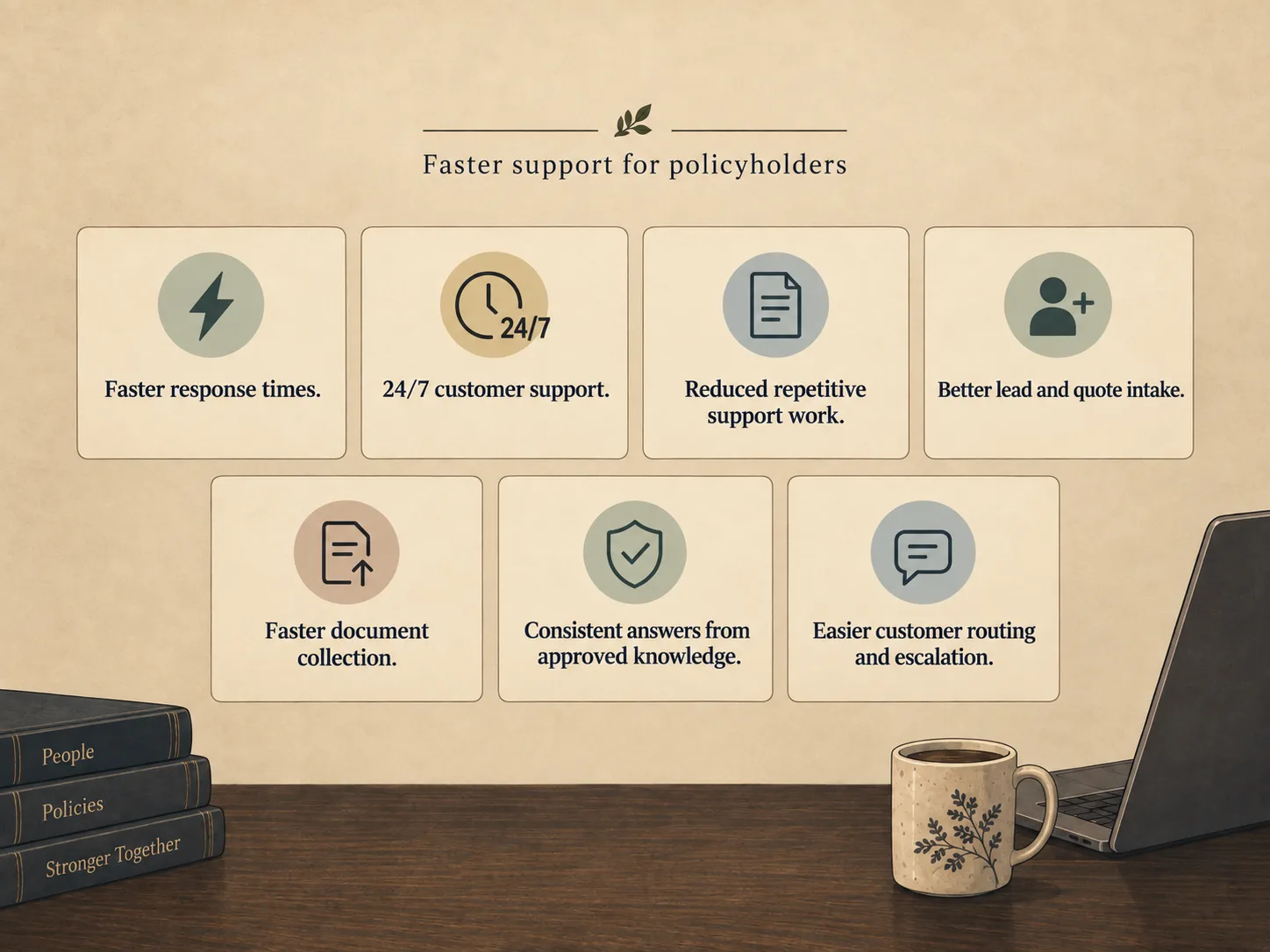
Faster response times. A voice or chat agent answers on the first ring or the first message, instead of a caller waiting on hold or a web visitor waiting for a callback.
24/7 customer support. Claims don't happen on business hours, and neither does the panic that follows one. An always-on layer catches what a staffed desk misses overnight and on weekends.
Reduced repetitive support work. Policy lookups, coverage explanations, and billing questions eat hours that a licensed producer could spend on actual sales or underwriting judgment calls.
Better lead and quote intake. A structured AI intake flow captures the details a quote needs before a human ever sees the lead, instead of a form that gets abandoned halfway through.
Faster document collection. Declarations pages, ID cards, and proof of prior coverage get requested and chased automatically instead of sitting in an inbox.
Consistent answers from approved knowledge. A well-grounded AI agent gives the same correct answer every time, where five different reps might give five different half-right ones.
Easier customer routing and escalation. The AI handles what it's allowed to handle and hands off cleanly the moment a question needs a license or a judgment call, with context intact.
Common AI customer service use cases in insurance
Policy and coverage questions. What's covered, what's excluded, what a deductible actually means on this specific policy.
Quote and lead intake. Structured data collection for auto, home, or commercial quotes before a human touches the lead.
Claims assistance and first notice of loss. Intake of the initial claim details, status checks, and document requests, with anything involving a payout or a coverage decision routed to a person.
Renewal and payment support. Reminders before a policy lapses, payment status, and simple billing questions.
Document collection. Chasing declarations pages, IDs, inspection photos, and signatures without a human having to follow up manually.
Appointment scheduling. Booking and rescheduling policy reviews, inspections, and renewal calls.
After-hours customer support. Coverage for the calls and messages that arrive after the office closes, which is when a lot of claims-related panic actually happens.
Multilingual customer service. Serving policyholders in their preferred language without hiring separate staff for each one.
What to look for in an AI customer service tool for insurance
Knowledge accuracy and grounding. The tool needs to answer strictly from your approved policy language and procedures, not from a general model's guess at what a typical policy usually says.
Human handoff and escalation. Coverage decisions, claims disputes, and anything requiring a license should route to a person immediately, with the full conversation history attached.
Security and compliance. What the vendor actually holds (SOC 2, HIPAA, GDPR) versus what it merely claims, and whether that maps to the data your workflows actually touch.
CRM and insurance system integrations. Whether it writes into the agency management system (AMS) or policy admin system you already run, rather than creating a second data source nobody checks.
Workflow automation. Whether the tool can actually update a record or trigger a process, not just describe what should happen next.
Omnichannel support. Chat, email, voice, and messaging apps like WhatsApp, ideally from one dashboard rather than three separate tools stitched together.
Voice support. Whether phone, still the highest-volume channel for most agencies, is a first-class feature or an afterthought bolted onto a chat product.
No-code customization. Whether your team can update the knowledge base and workflows themselves, or whether every change needs a ticket to the vendor's implementation team.
Pricing and usage limits. Whether the model is a flat seat price, a per-resolution charge, or a custom enterprise contract, and what happens to your bill when volume spikes.
Best AI customer service tools for insurance agencies in 2026
One disclosure before the list. This guide includes YourGPT, a platform this writer has a professional relationship with. Every entry below, including YourGPT, is judged against the same criteria above and sourced from the same public pricing pages and G2 listings, checked at the time of writing.
1. LLDTEK
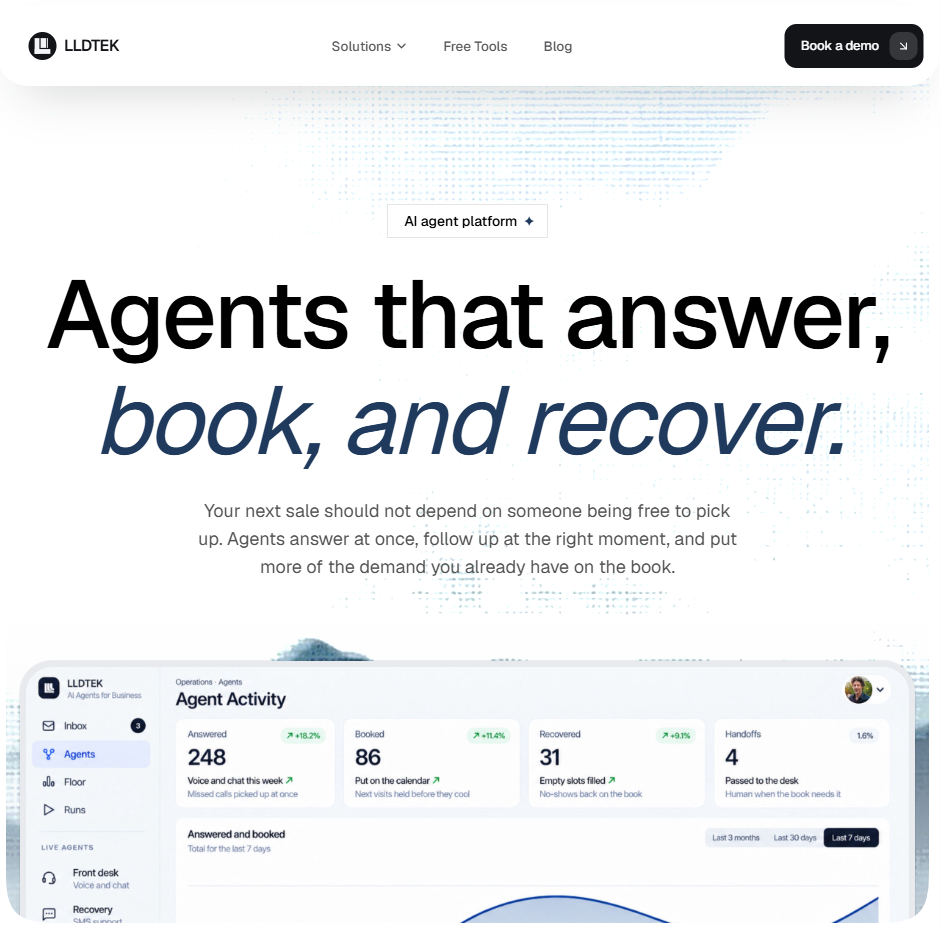
LLDTEK is built for a narrower job than the other tools on this list: front-desk call answering and appointment scheduling for service businesses, not general customer-service automation. It says outright it isn't a chatbot, and it doesn't do claims intake, policy Q&A, or ticketing.
For an insurance agency, that means answering after-hours calls, booking and rescheduling policy-review appointments, recovering no-shows, and sending renewal reminders, syncing into the calendar and phone line an agency already runs rather than a new system.
Features
Inbound call answering and appointment booking or rescheduling
No-show recovery with automatic rebooking
Renewal reminders and review-request outreach
Syncs with an agency's existing calendar and phone line rather than a separate database
Pros
Solves a real, specific problem, missed calls and no-shows, most of the other tools here aren't built around
Writes into systems an agency already runs instead of requiring a new one
Scoped narrowly enough that there's little to misconfigure
Cons
Doesn't handle policy Q&A, claims, billing, or anything the other tools on this list are built for
No public G2 listing found to independently check reviewer sentiment against
No published pricing found, get a number in writing before assuming it fits your budget
Pricing
Not publicly listed
Best for: agencies whose actual problem is missed calls and appointment scheduling, not full customer-service automation.
G2 rating. No G2 listing found at the time of writing.
2. YourGPT
YourGPT is a no-code AI agent platform built for support, sales, and operations rather than a product sold specifically for insurance. A team builds a conversational agent through a visual builder. Also, trains it on approved content, and deploys it across the channels a policyholder or prospect uses. Claims and quote workflows get built separately in AI Studio using branching logic and data capture, and the same platform handles support, routing anything it cannot answer to a person with full context.
Features
No-code agent builder with a visual workflow tool for multi-step logic
Omnichannel deployment across web, WhatsApp, Slack, and other channels
Knowledge base grounding to keep answers inside approved content
Connections to outside tools and data sources for live, real-time context
Human handoff with full context carried into the escalation
Support for more than 100 languages
Pros
Fast no-code deployment relative to enterprise-only agents in this category
Transparent, published monthly pricing instead of a sales-gated quote
One platform covers support, sales, and quote or claims-style workflows
No minimum ticket or conversation volume required to get started, unlike Ada’s 300,000-conversation qualification bar
Cons
Claims and quote logic has to be built out in AI Studio rather than arriving pre-configured for insurance
No publicly documented insurance-specific enterprise deployment on the scale of Ada’s health insurance work
Pricing
Essential: $39/month (annual billing)
Professional: $79/month (annual billing), the tier that includes AI Studio
Advanced: around $349/month (annual billing)
Enterprise: custom pricing
Best for: insurance teams that want one platform for support, claims-assistance conversations, and quote intake, without an enterprise-only sales process or a minimum volume requirement to qualify.
G2 rating. 4.7 out of 5 (G2).
3. Intercom Fin
Fin is Intercom's AI agent, and it carries by far the largest review base of anything on this list, a reflection of how broadly Intercom is already deployed across support teams. It resolves conversations across chat, email, phone, and WhatsApp with drag-and-drop configuration, working on top of Intercom's own helpdesk or standalone with Zendesk and Salesforce.
For an insurance agency, that means policy FAQ resolution and billing questions handled inside a support desk already running through Intercom, with the Expert tier adding HIPAA support for teams touching health-adjacent data.
Features
Cross-channel resolution over chat, email, phone, and WhatsApp
Drag-and-drop configuration, no engineering required
Copilot add-on that drafts replies for human agents
Works standalone with Zendesk and Salesforce, not just inside Intercom's own helpdesk
HIPAA support available on the Expert tier
Pros
Fast to set up and well documented
Backed by the deepest independent review base on this list, 3,887 G2 reviews
Works standalone on other helpdesks instead of locking an agency into Intercom's own inbox
Cons
Per-resolution billing counts a conversation as resolved even when a customer simply stops replying, which several G2 reviewers flag as a source of unpredictable bills at volume
HIPAA support requires the top Expert tier, not included at entry pricing
Pricing
Essential: from $29/seat/month (annual billing)
Advanced: from $85/seat/month (annual billing)
Expert: from $132/seat/month (annual billing), includes HIPAA support
Plus $0.99 per Fin resolution on top of any tier
Best for: insurance agencies already running support through Intercom, or that want an AI agent that also works standalone on top of Zendesk or Salesforce.
G2 rating. 4.5 out of 5 (G2), the largest review count of any tool on this list.
4. Zendesk AI
Zendesk repositioned around AI agents after its March 2026 acquisition of Forethought, now sold as "Advanced AI Agents" layered onto its existing ticketing platform. It's built natively into the Zendesk Suite, with the omnichannel ticketing workspace pulling in email, chat, messaging apps, and voice.
For an agency or carrier already running Zendesk, that means ticket deflection for policy and billing questions inside the existing ticketing setup, with automatic QA scoring useful for compliance review.
Features
Autonomous resolution across messaging, email, and voice
100 percent of AI interactions automatically scored for quality
Native to the Zendesk Suite's omnichannel ticketing workspace
Pros
Deep, mature ticketing infrastructure
Automatic quality scoring on every AI interaction
Cons
Resolution-based overage billing plus separate add-on costs mean the sticker price and the real monthly bill often diverge significantly, per multiple third-party pricing breakdowns
Pricing
Per-agent Suite plans as the base
AI agent resolutions billed at roughly $1.50 per resolution on committed volume or $2.00 pay-as-you-go, once the plan's small monthly allowance is used up
Copilot is a separate $50/agent/month add-on
Best for: agencies or carriers already running their support desk through Zendesk.
G2 rating. 4.3 out of 5 (G2), one of the largest and most established review bases in the category.
5. Ada
Ada is an AI customer service platform founded in 2016, now serving more than 350 enterprise customers including Monday.com, Pinterest, and YETI. Its core differentiator here is a published investment in health insurance member service, pre-built playbooks covering billing, claims status, in-network provider lookup, policy inquiries, and dependent updates. Ada runs on a Reasoning Engine, a single AI layer applying the same policies across chat, voice, and email, but its own pricing page states a minimum fit of 300,000 annual conversations, ruling out smaller insurance agencies regardless of budget.
Features
Reasoning Engine applying one unified policy layer across chat, voice, and email
Pre-built playbooks for the five highest-volume health insurance interactions
Multi-channel deployment across messaging, voice, and email
Backend integration with claims and member data systems
Trust and safety tooling for handling sensitive healthcare information
Automated conversation routing with multilingual support
Pros
The most publicly documented insurance-specific product investment of the five platforms here
A named auto-insurance customer, Clearcover, reported over 35 percent of chat inquiries auto-resolved within the first month of launch, according to a third-party case study roundup
SOC 2 enterprise security posture
One of the longest track records in this comparison, serving 350+ enterprise customers since 2016
Cons
Ada’s own pricing page sets a minimum fit of 300,000 annual conversations, which rules out smaller insurance agencies outright
No self-serve trial or free tier, every evaluation starts with a sales-led demo process
Pricing
No pricing page exists on the site
No dollar figures published anywhere
Every inquiry routes to a demo request, no self-serve quote tool
Best for: large health insurers with high member-chat volume who want pre-built content over heavy customization, and who clear Ada’s 300,000-conversation minimum.
G2 rating. 4.6 out of 5 (G2).
6. Decagon
Decagon builds AI agents through what it calls Agent Operating Procedures, plain-language instructions compiled into executable logic, running across chat, email, voice, and SMS from one platform. It connects natively to Zendesk, Salesforce, Stripe, and other systems of record, built on OpenAI, Anthropic, and Cohere foundation models.
That depth suits complex, multi-step service workflows for carriers or large agencies that need heavier automation than a simple FAQ bot, such as multi-system claims status lookups.
Features
Agent Operating Procedures for plain-language workflow logic
Simulation-based and regression testing
Live monitoring through its Watchtower tool
Actions like refunds or record updates through direct system integrations
Pros
Reviewers consistently praise implementation support
Depth of workflow logic the platform can handle
Cons
No public pricing at all
Small enough review base (18 reviews) that the rating carries less statistical weight than Ada's or Intercom's
Pricing
No self-serve pricing page
Third-party reporting puts an annual platform fee near $50,000, with per-conversation or per-resolution usage pricing on top
Total contracts reported anywhere from roughly $95,000 to $590,000 a year depending on scale
Best for: carriers or large agencies that need multi-step workflow automation heavier than a simple FAQ bot.
G2 rating. 4.9 out of 5 (G2), a strong score on a still-small sample.
7. Sierra
Sierra calls itself an Agent Operating System, built for enterprises where the AI agent becomes the primary customer-facing channel rather than a layer on top of a human team. It connects across chat, voice, SMS, WhatsApp, and email, with custom system integrations built during a sales-led implementation. Customers include SiriusXM, ADT, and Rocket Mortgage.
That positions it for full customer-facing automation at large carriers or brokerages that want AI handling policy changes and account actions end to end, not just answering questions about them.
Features
Action-taking agents that update CRMs, process refunds, and make system changes directly
Multi-model "constellation" approach the company says reduces hallucination risk
Custom system integrations built during a sales-led implementation
Pros
Founded by experienced enterprise operators
Reviewers cite genuinely strong action-taking capability rather than chat-only automation
Cons
G2 reviewers flag a steep learning curve
Limited self-service configuration, meaning most changes still require Sierra's own team
Pricing
Custom-quoted only, through enterprise sales
Third-party estimates put entry-level deployments around $150,000 a year
Implementation fees of $50,000 to $200,000 on top, with large multi-channel rollouts reaching $750,000 or more annually
Best for: large carriers or brokerages that want AI handling policy changes and account actions end to end.
G2 rating. 4.4 out of 5 (G2).
8. Fini
Fini is a YC-backed AI agent platform built for enterprise support in regulated industries, and insurance is one of its stated strongest fits. Instead of retrieval-augmented generation, Fini uses what it calls a reasoning-first architecture that evaluates each query against policy rules and knowledge before answering, which the company says is behind its reported 99% accuracy with zero hallucinations, the margin that matters when an agent is quoting coverage limits or claim eligibility.
Features
Reasoning-first query evaluation against policy rules rather than pure retrieval, per Fini
Always-on PII Shield redacting policyholder and health data in real time
20+ native integrations across helpdesks and CRMs, including Zendesk, Intercom, Salesforce, HubSpot, and Slack
Built to work with unstructured or messy policy documentation without a manual taxonomy rebuild, per Fini
Pros
Reasoning-first architecture Fini reports delivers 99% accuracy with zero hallucinations on coverage and claims queries
Broad compliance stack claimed: SOC 2 Type II, ISO 27001, HIPAA, PCI DSS Level 1, GDPR
Always-on PII Shield for real-time redaction of sensitive policyholder data, per Fini
Fast reported deployment (14 days) against the multi-month rollouts quoted elsewhere on this list
Cons
Only 6 G2 reviews to independently check the accuracy and compliance claims against
The $0.49-per-resolution figure is Fini's top enterprise-tier overage rate, not its entry price, published plans start near $3,000/month
Pricing
Growth: roughly $3,000/month for 2,000 resolutions
Scale: roughly $7,500/month for 8,000 resolutions
Enterprise: custom, with per-resolution overage reported as low as $0.49 at this tier
No published free tier
Best for: insurance carriers, brokers, MGAs, and health plans that want a reasoning-first agent with a broad reported compliance stack and fast deployment, and that can work within Fini's plan minimums rather than needing self-serve entry pricing..
G2 rating. 5.0 out of 5 (G2), a small sample worth noting given how young the review base is.
9. Cognigy
Cognigy, now operating as NiCE Cognigy after a $955 million acquisition NiCE announced in July 2025, is a long-established enterprise conversational AI platform with a specific, named track record in insurance and banking contact centers. It connects to Genesys, Avaya, NICE CXone, Amazon Connect, Salesforce, and ServiceNow.
That voice-first architecture suits large-scale automation for carrier call centers specifically, including claims intake calls and policy servicing lines, alongside chat and WhatsApp.
Features
Visual, low-code flow builder
Native voice gateway for telephony
Support for 100+ languages across enterprise contact center deployments
Pros
The strongest native voice and telephony integration on this list
Named history serving insurance carriers specifically
Cons
Enterprise-only pricing
A 2 to 4 month typical implementation window puts it out of reach for anything smaller than a sizable carrier or MGA
Pricing
Enterprise sales only, no self-serve tier
Reporting places entry contracts around $2,500 to $5,000 a month
Scaling to $100,000 to $350,000 or more annually for larger deployments
Best for: carrier call centers that need large-scale voice automation, including claims intake and policy servicing lines.
G2 rating. 4.6 out of 5 (G2).
AI customer service tools for insurance agencies compared
# | Tool | Scale Fit | AI Capabilities | Integrations | Self-Learning / Improvement | Published Resolution Rate* | Omnichannel | Pricing |
|---|---|---|---|---|---|---|---|---|
1 | LLDTEK | Small to mid-size, appointment-led teams | Voice AI, intent detection, booking, follow-ups, lead qualification and handoff | Calendars, booking/POS systems and connected business tools | Not clearly documented as a self-learning system | Not publicly published | Yes — voice, SMS, web messaging and email | Not publicly published |
2 | YourGPT | Small teams to enterprise | No-code AI agents, knowledge-based answers, multi-step workflows, API/function calls, voice AI and human handoff | WhatsApp, Instagram, Messenger, Email, Slack, Discord, Telegram, LINE, Twilio SMS/Voice, API/webhooks | Yes — unresolved conversations surface knowledge gaps and feed improvement; self-learning is included on Professional and higher plans | 90%+ autonomous resolution reported in production deployments; results vary by data and integrations | Yes — web, messaging, email, SMS and voice | From $39/mo annually or $59 month-to-month; Professional from $79/mo annually |
3 | Intercom Fin | SMB to enterprise | AI reasoning, knowledge answers, Procedures/actions, customer-data access, service, sales and ecommerce roles | Intercom plus Salesforce, HubSpot, Freshworks and other helpdesks/custom integrations | AI-assisted — analyzes unresolved conversations and recommends content, data and action improvements; teams approve changes | 76% average customer-query resolution claimed by Intercom | Yes — web/mobile Messenger, email, phone, WhatsApp, SMS, Facebook and Instagram | From $29/seat/mo annually + $0.99 per Fin outcome |
4 | Zendesk AI | SMB to large enterprise | Agentic AI, multi-step reasoning, Action Builder, workflows, connected knowledge and human escalation | Zendesk ecosystem plus APIs and external system integrations | Yes — Resolution Learning Loop is designed to improve AI agents from outcomes over time | Zendesk advertises up to 80%+ resolution of complex service issues | Yes — social, web, mobile, voice and email | Suite Team from $55/agent/mo annually; AI resolution usage is outcome based |
5 | Ada | Mid-market to enterprise | Reasoning Engine, Playbooks, API Actions, autonomous workflows, safety controls and human handoff | Zendesk, Salesforce, Freshworks, Genesys, NICE CXone, Twilio Flex, Amazon Connect and others | Yes — Coaching applies insights from previous conversations to future interactions | 84% automated resolution rate reported by Ada across its platform deployments | Yes — voice, email, chat, Messenger, WhatsApp, SMS, Instagram, in-app and custom channels | Custom / sales-led |
6 | Decagon | Mid-market to enterprise | Agentic customer support, complex workflow execution, personalized chat, voice and email automation | Salesforce, Intercom, Zendesk, Confluence, Contentful, Kustomer, Amazon Connect, RingCentral, MCP and APIs | Yes, with review — Duet Autopilot converts production signals into proposed agent updates that can be reviewed before deployment | Vendor showcases 70% chat and voice resolution in customer outcomes; no single universal platform-wide rate is published | Yes — chat, voice and email | Custom / contact sales |
7 | Sierra | Enterprise | Advanced reasoning, end-to-end task execution, system-of-record actions and multi-step workflows such as claims, returns and account changes | Connects with CRM, order-management and other systems of record | Continuous optimization — monitoring, insights and Ghostwriter help build and improve agents over time | No single platform-wide rate published; Sierra case studies report 64% at AOL and around 70% at OluKai | Yes — chat, SMS, WhatsApp, email, voice and ChatGPT | Custom outcome-based pricing |
8 | Fini | Mid-market to enterprise | Agentic actions, complex ticket resolution, internal API calls, Knowledge Atlas, guardrails and regulated-industry workflows | Zendesk, Intercom, Front, LiveChat, Salesforce, Gorgias, HubSpot, Slack and custom integrations | Yes — Knowledge Atlas identifies gaps and Fini positions its agents as continuously self-improving | 90% resolution / 99% accuracy reported by Fini across production deployments | Yes — chat, email, widget and voice | Growth $0.89/resolution, Scale $0.69, Enterprise from $0.49/resolution |
9 | Cognigy | Enterprise contact centers | Agentic + deterministic workflows, multi-agent orchestration, memory, tool actions, multimodal AI and advanced Voice AI | 100+ prebuilt integrations, including Genesys, NICE CXone, Intercom, Teams, Slack, Twilio and contact-center systems | Yes — Cognigy states its newer agent architecture can learn from production traffic; analytics and testing provide additional improvement loops | No universal platform-wide rate; one Cognigy customer case study reports 50%+ resolution | Yes — voice, web chat, messaging and 30+ omnichannel connectors | Custom / contact sales |
* Resolution rates are not directly comparable. Vendors use different definitions, datasets, channels and eligible-conversation criteria. Treat these numbers as vendor-reported benchmarks rather than independent head-to-head test results.
Which insurance customer service tasks should AI handle?
Tasks suitable for AI
Policy information retrieval
Quote intake
Lead qualification
Renewal reminders
Document collection
Claim-status questions
Appointment booking
Tasks better handled by humans
Complex coverage questions
Claim disputes
Claim denials
Underwriting decisions
Sensitive complaints
Legal or regulatory issues
Licensed insurance advice
The line between the two lists is fairly bright. If getting it wrong could cost a customer their coverage, their claim, or a legal right, a licensed person makes that call, not the AI.
AI chatbot vs AI agent for insurance agencies
What an AI chatbot does. It matches a customer's question to a scripted or retrieval-based answer and stops there. Useful for FAQs, weak the moment a request needs an action taken.
What an AI agent does. It holds a full conversation, reasons over multiple steps, and takes action in connected systems, updating a record, sending a document, booking a callback, rather than only describing what should happen.
When agencies need workflow automation instead of basic chat. Once a request involves more than one step, checking a policy status and then rescheduling a review and then logging the outcome, a chatbot runs out of road. That's the point to move to a tool built around actions and integrations rather than answers alone.
How to choose the right AI customer service tool for your insurance agency
Identify your highest-volume customer requests before evaluating anything.
Define what the AI can and cannot answer, in writing, before a vendor call.
Review security and compliance requirements against what a vendor actually holds, not what it claims.
Check required integrations against your actual agency management system and CRM.
Test the tool with real insurance documents from your own book, not vendor demo content.
Test human escalation specifically, not just the happy path.
Compare pricing models against your real volume, not the headline number.
Start with one high-volume workflow before expanding to others.
How to implement AI customer service in an insurance agency
Before deployment
Identify customer intents from real call and ticket logs
Prepare the knowledge base from approved policy language and procedures
Define escalation rules in writing before launch
Review what sensitive data the tool will touch
Connect required systems ahead of go-live, not after
During testing
Test common customer questions
Test ambiguous questions that don't map cleanly to one intent
Test what happens when the AI's assumptions are wrong
Test system failures, not just the happy path
Test human handoff specifically
Test multilingual conversations if you serve non-English speakers
After launch
Review unanswered questions weekly
Monitor for incorrect responses, not just resolution counts
Update knowledge sources as policies and procedures change
Track escalation rates over time
Add new workflows gradually rather than all at once
How to measure AI customer service performance
Automated resolution rate. How much volume the AI closes without a human.
First-response time. How quickly a customer gets an initial reply.
Average resolution time. How long a full interaction takes end to end.
Human escalation rate. How often the AI hands off, and whether that rate is trending down as the knowledge base improves.
Customer satisfaction. Whether customers report the interaction actually solved their problem.
Cost per conversation. The all-in cost, including any per-resolution or per-seat fees, divided by volume.
Quote completion rate. How many AI-assisted quote conversations actually finish.
Lead conversion rate. How many AI-qualified leads convert to policies.
Incorrect-answer rate. How often the AI gets something wrong, tracked separately from resolution rate, since a fast wrong answer is worse than a slow right one.
Challenges of using AI customer service in insurance
Incorrect or unsupported answers. An AI agent that answers confidently and wrongly on a coverage question creates real liability, not just a bad customer experience.
Outdated policy information. A knowledge base that isn't kept current will confidently repeat last year's terms.
Sensitive customer data. Claims and policy data often includes financial and sometimes health information, which raises the compliance bar significantly.
Regulatory requirements. Insurance is regulated at the state level in the US, and advice-adjacent answers can cross into licensed-producer territory without anyone noticing until it's a problem.
Integration complexity. Legacy agency management systems and policy admin platforms weren't built with modern APIs in mind, and that shows up in implementation timelines.
Over-automation. Routing too much to AI, including things that genuinely need a human's judgment, erodes trust faster than it saves time.
Poor human handoff. A customer who has to repeat themselves after being escalated experiences that as a failure, even if the AI part of the interaction worked fine.
Questions
Frequently asked questions
It depends on scale. YourGPT and Fini fit individual agencies and mid-size teams that want no-code setup without an enterprise contract. Ada, Sierra, and Cognigy are built for carriers and large MGAs running hundreds of thousands of conversations a year.
Yes, when it's grounded in the agency's own approved policy documents rather than a general model's guess. Coverage nuances specific to an individual policy should still route to a licensed producer.
AI can handle first notice of loss intake, status checks, and document collection. Claims disputes, denials, and anything involving a payout decision need a person.
Yes. Structured intake flows can capture the details a quote needs, vehicle information, coverage preferences, prior claims history, before a human agent ever sees the lead.
It depends entirely on the vendor. Ada holds SOC 2 Type 2, GDPR, and HIPAA certifications. Several other tools on this list keep pricing and security details behind a sales call, which is itself worth asking about directly before signing anything.
Only if it touches health information directly, which mostly applies to health and life insurance workflows. Auto and home insurance customer service tools typically don't need it, though it's worth confirming for your specific data flows.
No, not entirely. It can absorb the repetitive volume, policy lookups, billing questions, renewal reminders, freeing licensed staff for coverage decisions, claims judgment calls, and the conversations that actually need a person.
Most tools on this list integrate with common CRMs and helpdesks like Salesforce, HubSpot, and Zendesk. Direct native integration with agency management systems (AMS) or policy admin platforms varies by vendor and is worth testing before committing.
Entry-level, no-code platforms start around $49 to $99 a month. Mid-market tools run into the thousands per month. Enterprise platforms built for carriers commonly run six figures annually once implementation is included.
A chatbot answers questions from a script or knowledge base and stops there. An AI agent holds a full conversation and takes action in connected systems, updating records, sending documents, booking appointments, instead of only describing what should happen next.
Final Verdict
Match the tool to your actual volume before anything else. An agency with a few thousand conversations a year evaluating Sierra or Ada is shopping in the wrong aisle, the same way a national carrier trying to run claims automation on a $49/month plan is shopping in the other wrong aisle. Start with the tools built for your scale, test human handoff specifically, and let the pricing model tell you as much as the feature list does.
Updated Sep 29, 2026.