Blog/Guides
Explore 5 Retrieval Augmented Generation Trends
Most "AI agents" can only answer questions, not act. Here's what's changing in Retrieval-Augmented Generation trends for 2026, with real data.
Oct 12, 2026 · 12 min read

Ask three teams what their RAG system does and you'll get three different answers. One has a chatbot sitting on a folder of PDFs. One has a search box with a language model bolted on. One has an agent that books appointments. Same acronym, very different machines.
Here is where retrieval-augmented generation actually stands in 2026. Five shifts are reshaping how it's built: agents that decide how to retrieve, hybrid search with reranking as the new floor, retrieval wired straight into live business systems, indexes that understand structure and page layout, and governance that treats every lookup and every write as something you can audit. Most teams only need the first couple of upgrades. The rest earn their place when you can point to a specific failure they fix, and a table near the end ranks them by what to try first.
What is Retrieval-Augmented Generation in one minute (and what hasn't changed)
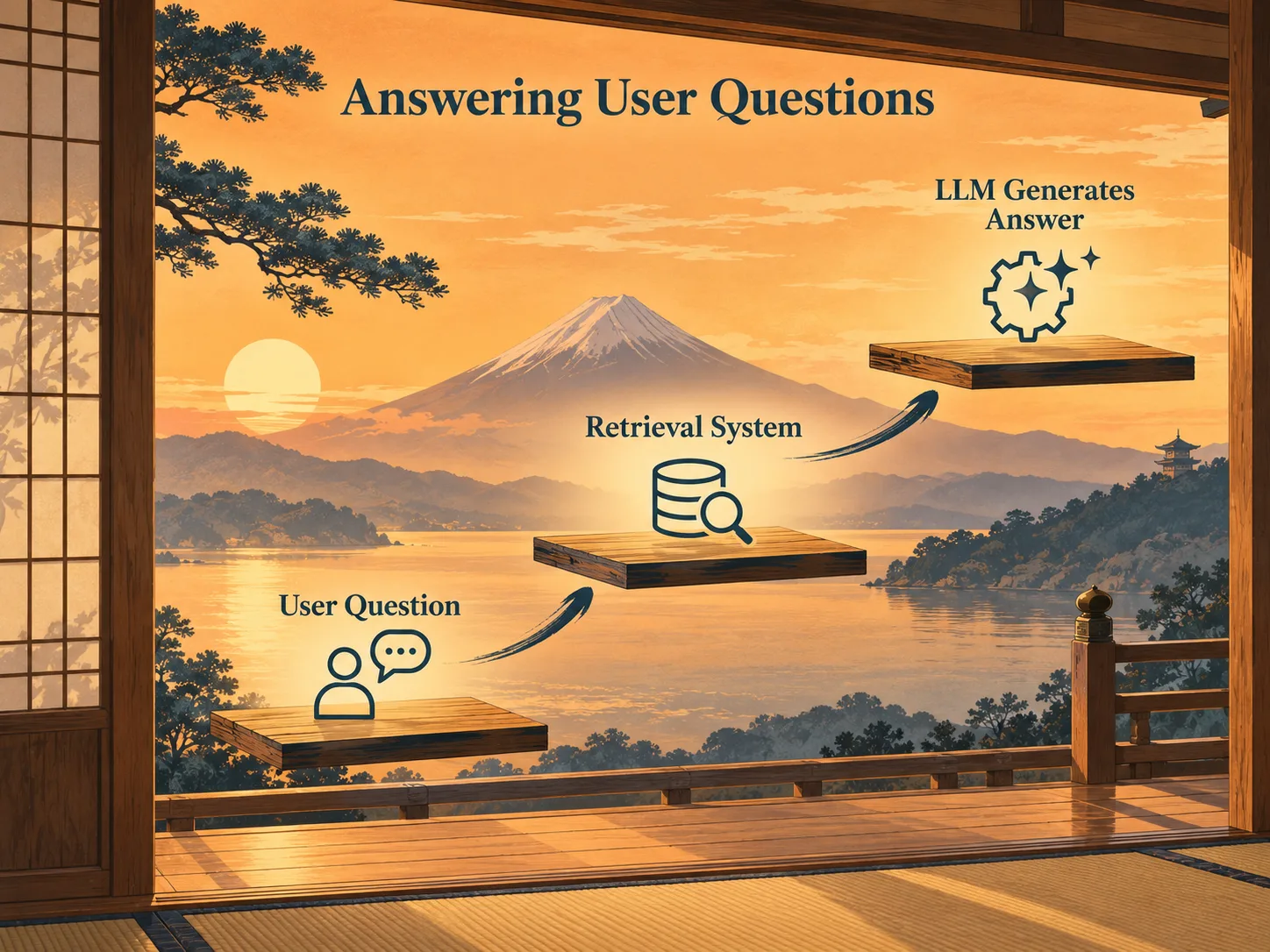
RAG gives a language model a lookup step. Your question gets turned into a vector, compared against pre-processed knowledge (chunked documents, database rows, API responses), and the closest matches are handed to the model as context. The model answers from that material instead of from memory. If you want the difference between RAG and plain semantic search spelled out, the guide on RAG vs semantic search covers it.
The plumbing is the same as it ever was: a knowledge source, chunking, embeddings, a vector store, query encoding, retrieval, context injection, generation, and a refresh cycle so the index doesn't rot. The payoff hasn't changed either. You get answers grounded in something you can point to, knowledge you can update without retraining, and private content kept out of model training. One caveat on that last part: retrieved passages still travel to the model as context, so read your provider's data terms.
The weak spots haven't moved. If retrieval is poor, the answer is poor, because the model only sees what it's handed. Retrieval adds latency. A working setup takes real engineering. Biased sources produce biased answers. Everything below is, one way or another, a fix for one of those four problems.
Trend 1: Agentic RAG makes retrieval a decision, not a step
Classic RAG works like a vending machine. Question in, one lookup, answer out. Agentic RAG is closer to a researcher. The model decides whether to look anything up at all, rewrites or splits a vague question, checks whether the results really answer it, and goes back for more when they don't (Zilliz).
Picture a support agent asked whether a customer qualifies for a discount. It first finds which plan the customer is on, then pulls the discount rules for that plan, then answers. Zilliz describes this exact pattern. One lookup can't do it, because the second question depends on the answer to the first. Mindbreeze lists agentic RAG among its five enterprise AI trends for 2026.
Now for the cold water. Sinequa surveyed 740 senior executives at companies with $1B to $20B+ in revenue. About 71% said their most advanced deployment was assistive AI or below, meaning tools that retrieve well but can't pursue a goal or take an action. Only 10% showed multi-agent systems, and 84% had run into products sold as agents that were really sophisticated chatbots (Sinequa). Sinequa sells enterprise search, so weigh the framing accordingly, but the test it suggests is a good one. Can the system rewrite its own query when the first try fails? Can it finish the job, or does it only describe it?
Loops aren't free. They behave a little differently on every run, each extra retrieval adds waiting time, and a loop with no limit can spin until it times out and hands you the bill. Practitioners keep landing on the same compromise: a fast fixed pipeline for everyday single-source questions, an agentic path for requests that span several sources or steps, a hard cap on iterations, and a fallback to plain retrieval when the loop gives up (eCarter, Parloa).
Trend 2: Hybrid search plus reranking is the new floor
Pure vector search has a blind spot. Embeddings are good at meaning and surprisingly poor at exact strings, so a question about a specific SKU or invoice number can return something that merely sounds similar (Zilliz).
The fix is to run keyword search (usually BM25) and vector search side by side and merge the two ranked lists, often with reciprocal rank fusion. You cast a wide net first, commonly 50 to 100 passages. Then a cross-encoder reranker reads each candidate against the actual question and keeps only the best few for the model (overview).
A number of practitioner guides now call this keyword, vector and rerank stack the 2026 production baseline (example). That's consensus among builders, not a controlled benchmark, so don't take it on faith. Collect a set of real questions from your own business, run both versions, and count how often the right passage lands near the top.
"Hybrid" has also stretched past text. One answer can now draw on three kinds of retrieval: vector search over unstructured policy or product content, structured queries with filters for things like price or availability, and direct API calls to a system of record. Here's an illustration. A dispatcher agent takes a call about a broken unit. It needs the warranty terms from documents, the technician's real schedule from a database, and a write to book the visit. No single retrieval method covers all three.
If you only act on one thing in this article, make it this one. It improves answers without adding the unpredictability of an agent, and you can measure the gain.
Trend 3: Retrieval reads live systems, through shared standards
For years the usual setup was to index an export of the FAQ or policy library and refresh it on a schedule, which meant every answer was only as fresh as the last export. Zilliz calls the failure embedding drift: the data changes after indexing and the agent keeps serving the old version. The 2026 pattern skips the middleman. The agent asks the system of record at the moment of the question, whether that's a calendar, a CRM, a point-of-sale system or a ticket queue, and writes any change back to the same place.
Shared standards are making this easier to build. The Model Context Protocol (MCP) is an open protocol for connecting AI applications to external tools and data. Anthropic donated it to the Linux Foundation's Agentic AI Foundation on December 9, 2025. The foundation was co-founded by Anthropic, Block and OpenAI, with support from Google, Microsoft, AWS, Cloudflare and Bloomberg. In practice, a common connector standard means you don't hand-build a separate integration for every pairing of AI tool and business system.
There's a design argument here as well. Reading from the system a business already runs beats copying it into a parallel database, because every extra copy is another place for stale or wrong answers to sneak in. The RAG vs semantic search guide makes a useful distinction on this point: retrieval handles what someone wrote down, while a live connection handles what is true right now, such as whether Saturday at 3pm is still open.
Three examples of the pattern follow. They're design illustrations, not measured results.
Customer support. An agent connected to the helpdesk, the CRM and the payment system can answer a refund or plan question from the live account instead of a help-center export, then hand the case to a person when it needs one. The handoff matters as much as the lookup. Test any vendor's resolution-rate claims on your own tickets before you believe them.
Appointment-based businesses. A voice and chat agent built for appointment-based businesses can check a salon's booking system for a real open slot instead of reading back typical hours. The same idea works for clinics and gyms. If it also writes the new booking to the calendar the front desk already uses, it can finish a rebooking in one conversation, where a scripted reminder just asks someone to call. You can watch one handle a real rebooking call and judge for yourself.
Field service. A field service dispatcher agent can read a live maintenance log, see which technician is free and book the inspection in one pass. That replaces the phone tag that normally sits between a warning sign and a visit.
Live access has a price. Permissions, rate limits and latency all enter the retrieval step, and every write raises the cost of a mistake. That is what the fifth trend is about.
Trend 4: Indexes learn about structure and layout
Chunk-and-embed treats a document collection like a pile of text snippets. That throws away two things: how entities relate to each other, and what a page actually looks like.
GraphRAG goes after the first. Microsoft Research points out that conventional RAG struggles with questions about a whole corpus, such as what its main themes are, because that's a summarization job rather than a retrieval job. Their method has an LLM pull an entity knowledge graph out of the documents, then pregenerate summaries for each cluster of closely related entities. At query time every cluster summary produces a partial answer, and those get merged into one response. On global questions over datasets of roughly a million tokens, the authors report answers that were noticeably more comprehensive and diverse than a conventional baseline (Edge et al., 2024). The bill arrives at indexing time, because building the graph and summaries takes a lot of LLM calls. If your users mostly ask for single facts, you may never earn that cost back.
Page-image retrieval goes after the second. The ColPali paper, presented at ICLR 2025, observes that text-extraction pipelines are slow, brittle and throw away visual cues such as figures, tables and layout. Its answer is to embed images of the document pages directly with a vision language model. On ViDoRe, a benchmark the same team built, it largely beat modern retrieval pipelines while being simpler and faster (Faysse et al., 2025). That's a research result on the authors' own test, so try it on your scans, charts and tables before betting on it.
Before adding either one, work out where your failures really come from. Wrong answers caused by missing links between documents point toward a graph. Answers that miss what sat inside a table or chart point toward page images. And if the right passage is being found but buried at rank 40, go back to trend 2.
Trend 5: Governance, provenance and evaluation stop being optional
When an agent only reads, a wrong answer becomes a support ticket. When it can also write, a wrong action becomes a double-booked appointment, a billing error, or a cancellation nobody wanted. That gap is why trust has become a headline topic. Mindbreeze puts provenance, privacy and governance on its 2026 trend list and argues that trust is turning into a measurable KPI.
The adoption numbers explain the pressure, with a catch. CrewAI surveyed 500 senior leaders at organizations with $100M+ in revenue and 5,000+ employees. It found that 81% had fully adopted or were actively scaling agentic AI, and every respondent planned to expand it in 2026 (CrewAI). Sinequa's survey of larger companies painted a far more cautious picture of what those deployments can really do. Both can be right. CrewAI measures how widely agents are being rolled out, while Sinequa measures how capable the best deployment is. Both publishers sell agent or search platforms, so neither is a neutral census.
For a RAG agent, governance boils down to four habits:
Provenance. Every answer points to the passage or record it came from, with a timestamp, so a reviewer can check it.
Permissions. Retrieval respects the asking user's access rights, so the agent can't surface something that person couldn't open themselves.
Controlled writes. Decide which actions the agent may take alone, which need confirmation, and which go to a person. Keep an audit trail and a way to roll back. Parloa describes that trail as what lets regulated teams show their customer-facing answers met their obligations.
Evaluation. Keep a fixed set of questions and measure retrieval quality and answer grounding before and after every change. Zilliz suggests tracking retrieval recall and how many loop iterations each question takes. If you can't measure it, you're guessing.
Which trend to adopt first
Start with the cheapest, most measurable change and add complexity only where a specific failure demands it. This order reflects that principle, and it is a recommendation, not a ranking from a study.
Order | Trend | What it fixes | Main cost or risk | Adopt when |
|---|---|---|---|---|
1 | Hybrid search and reranking | Missed exact matches, relevant passages ranked too low | Extra reranking latency | Almost any production RAG system |
2 | Governance, provenance and evaluation | Unverifiable answers, unsafe writes, silent regressions | Process and tooling effort | Before any agent can write, and ideally before launch |
3 | Live systems through open standards | Stale answers from exported data | Permissions, rate limits, write risk | Answers depend on data that changes daily |
4 | Agentic RAG | Questions that need several sources or steps | Latency, cost, non-determinism | Single-pass retrieval measurably fails |
5 | Graphs and page images | Cross-document questions, tables and figures lost in text | Heavy indexing cost | Failures trace to structure or layout |
Questions
Frequently asked questions
It's a method that lets an AI model look something up before it answers, instead of relying only on what it learned during training. The model retrieves relevant information, such as a document, a database record, or a live system status, and uses that to generate a grounded response rather than a guess.
Traditional RAG retrieves information and stops there, leaving a human to act on the answer. Agentic RAG adds a reasoning and execution step, so the system can decide what to do with what it retrieved, such as booking an appointment, updating a record, or escalating a request, without a person handling the handoff.
Usually because the retrieval source itself is stale or incomplete, not because the model is malfunctioning. A vector store built from an outdated export will confidently repeat outdated information. Grounding the agent in live, transactional data instead of a static document store closes most of this gap.
Yes, when the retrieval layer is connected to the live system of record, such as a calendar or point-of-sale platform, rather than a static knowledge base. The agent checks real availability and writes the result directly to the system the business already uses, rather than generating an answer someone still has to act on manually.
The shift from single-source vector retrieval to hybrid retrieval that combines unstructured documents, structured database queries, and live API calls in one response. That combination is what allows an agent to move from answering a question to completing the task behind it.
The Verdict: What to Actually Check Before You Trust One
When you're evaluating one of these systems, the vector database brand tells you far less than how the thing behaves. Ask these four questions.
Does it read your live systems, or a periodic export? Match freshness to the data. Pricing, availability and order status move daily, so they need a live connection or very frequent re-indexing. A policy library that changes twice a year doesn't.
Can it finish the task, or only hand back an answer someone has to carry out? That gap is the line between assistive AI and the agentic systems Sinequa found in only 10% of respondents.
What happens when it writes something wrong? Ask to see the audit trail and the rollback path before it gets near a calendar, a CRM record or a billing system.
How was it evaluated? Ask for retrieval and groundedness results on questions from your business, not a vendor's demo set.
The teams that get the most out of RAG this year will likely be the ones whose retrieval layer keeps the shortest distance between what the agent says and what's actually true.
Updated Oct 19, 2026.