Blog/Guides
6 Best Chatbase Alternatives in 2026
Compare six serious Chatbase alternatives by what the agent can finish, how usage is billed, and what happens when the meter runs out.

Owen Hart
Nov 2, 2026

The best Chatbase alternative depends on what the agent has to finish once it stops answering questions. Choose LLDTEK when calls and messages must become correctly placed appointments in a live booking system. Choose YourGPT when you want Chatbase-style training plus more agents, tools, and a helpdesk under one self-serve plan. Choose Intercom Fin when you want resolution billed per outcome on top of the helpdesk you already run. Botpress suits teams building multi-step support agents with developers in the loop, Voiceflow suits CX teams running chat and voice at scale, and Tidio is the simplest pick for a small store that wants live chat with a capped AI agent.
Chatbase built its name on one idea: paste a URL, upload your documents, and get a chatbot trained on your content. The homepage now sells something larger, conversational agents for customer experience across chat, email, and voice, used by "10,000+ brands" and "ready in minutes." Agents can run actions such as order lookups, plan changes, and invoice retrieval, and the Cal.com action can read an event's slots and book a meeting inside the chat.
The limits sit in the meter. Every self-serve plan on the Chatbase pricing page includes one AI agent, including Business at $400 a month billed yearly. A second agent is $300 a year. Credits are charged per response, and the Chatbase FAQ lists 2 credits per response for models such as Claude 5.5 Sonnet and GPT-6.1, 4 for GPT-5.5, and 5 for Claude 5.5 Opus. When credits run out, the FAQ says the agent shows "This AI Agent is currently unavailable." On a busy Saturday, that message is the support channel.
Accuracy is the other leak. On Trustpilot, Chatbase holds 4.1 from 73 reviews, but a quarter of them are one star. One September 2026 reviewer wrote "Often incorrect." Another described charges that continued after cancellation. Chatbase's homepage features a Sandbox VR case study citing 93% resolution *accuracy*. Accuracy on the questions it answered is not the share of conversations it resolved.
Compare Chatbase as it is sold today: a fast, document-trained agent with light actions, one agent per plan, and a per-response meter that switches the bot off at zero. Then decide whether you need more agents, a metered resolution layer, a builder for complex flows, or a system that writes into a real appointment book.
Pricing in this guide reflects the vendors' official pages as of October 2026. Plans change often, so confirm the final quote before signing.
Choose for the Need, Not the Brand
Chatbase alternatives fall into four groups. Trained-agent platforms take your content and add tools, channels, and escalation. Resolution layers sit on top of an existing helpdesk and charge for outcomes. Agent builders give developers and CX teams a canvas for multi-step logic, voice, and integrations. Appointment systems must do something none of the others are designed for: read staff, service length, rooms, and availability before writing a visit into the calendar.
A chatbot that answers "What are your hours?" well can still fail the business when the customer wanted a refund processed, an order changed, or a 90-minute treatment booked with a named therapist. Test every product against the same week of real conversations, not against six demos with six definitions of success.
Chatbase alternatives at a glance
Chatbase vs the six alternatives
Read the table against last month's conversations, not against the vendor's sample bot. A cheaper plan still loses if the busiest week ends with an agent that says it is unavailable.
The six best Chatbase alternatives
Ranked by how much finished work each one delivers for a business leaving Chatbase, from booked visits to resolved tickets.
1. LLDTEK
LLDTEK
Appointment operationsBest for: Salons, spas, clinics, studios, and service businesses where a call or message has to end as a correct booking
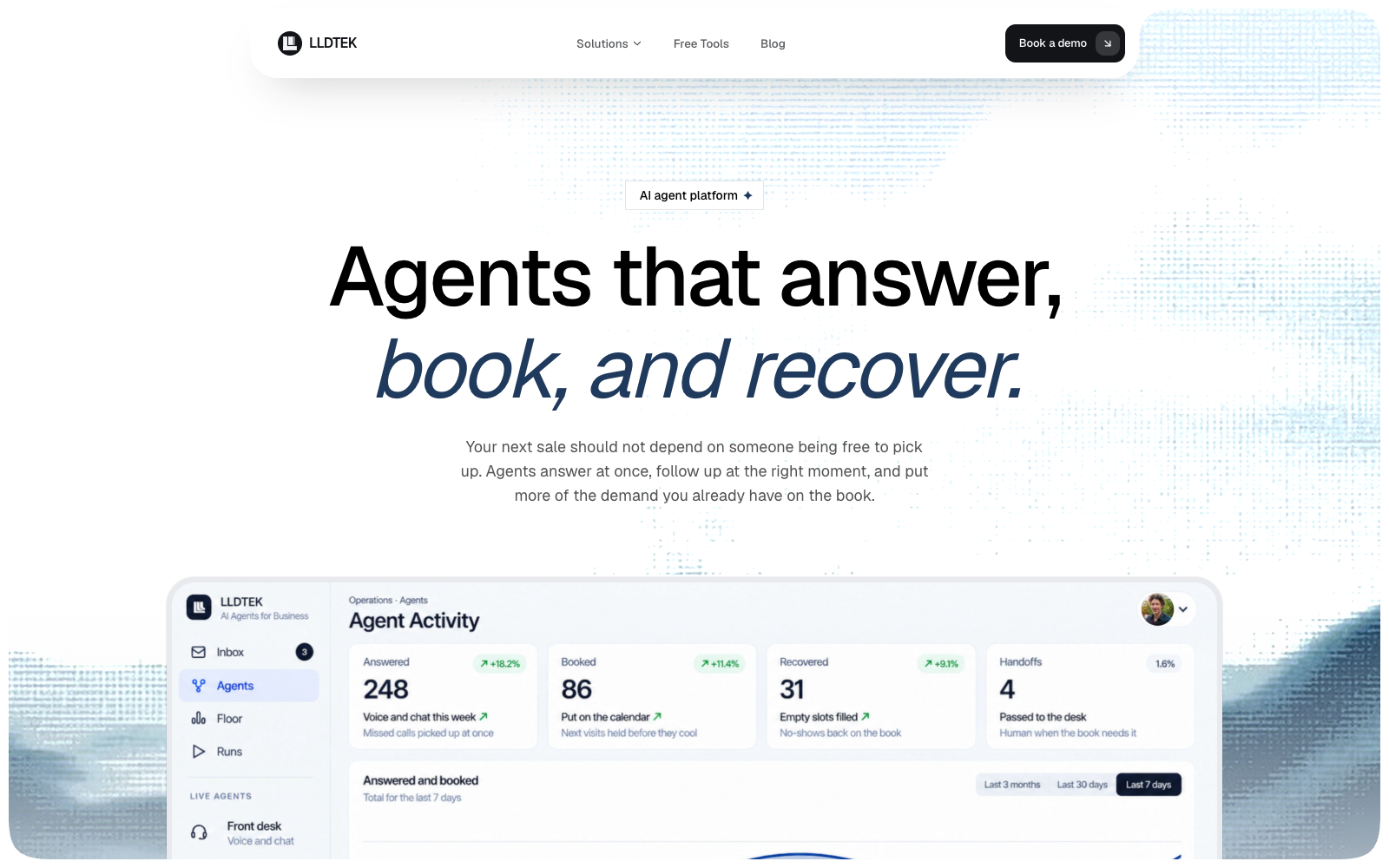
LLDTEK is the specialist Chatbase alternative for businesses where the answer is only useful if it lands in the book. Chatbase can show Cal.com slots for one event type. LLDTEK's agents work against the booking system a salon, spa, or clinic already runs, so the offer respects who is free, how long the service takes, and which chair is open. Front-desk, recovery, rebooking, reputation, and floor agents share one layer across voice, SMS, and web. A cancellation can trigger controlled waitlist outreach, a finished visit can prompt the next booking, and VIP requests, disputes, and off-menu asks stop for a person. Pricing is scoped after reviewing locations, channels, integrations, and the jobs to staff, which makes the scoping call part of the evaluation.
Pros
- Checks live availability before offering a staff member or time
- Covers missed calls, texts, and web chat in one operating layer
- Leaves the existing POS as the system of record
- Hands VIP requests, disputes, and off-menu asks to staff
Cons
- No self-serve plan or public price list
- Wrong category for a general documentation bot
- Needs real scheduling rules before a useful trial
- Smaller public review footprint than older chatbot vendors
2. YourGPT
YourGPT
Configurable AI agentsBest for: Teams that like Chatbase's train-on-your-content model but need more agents, tools, a helpdesk, and human escalation
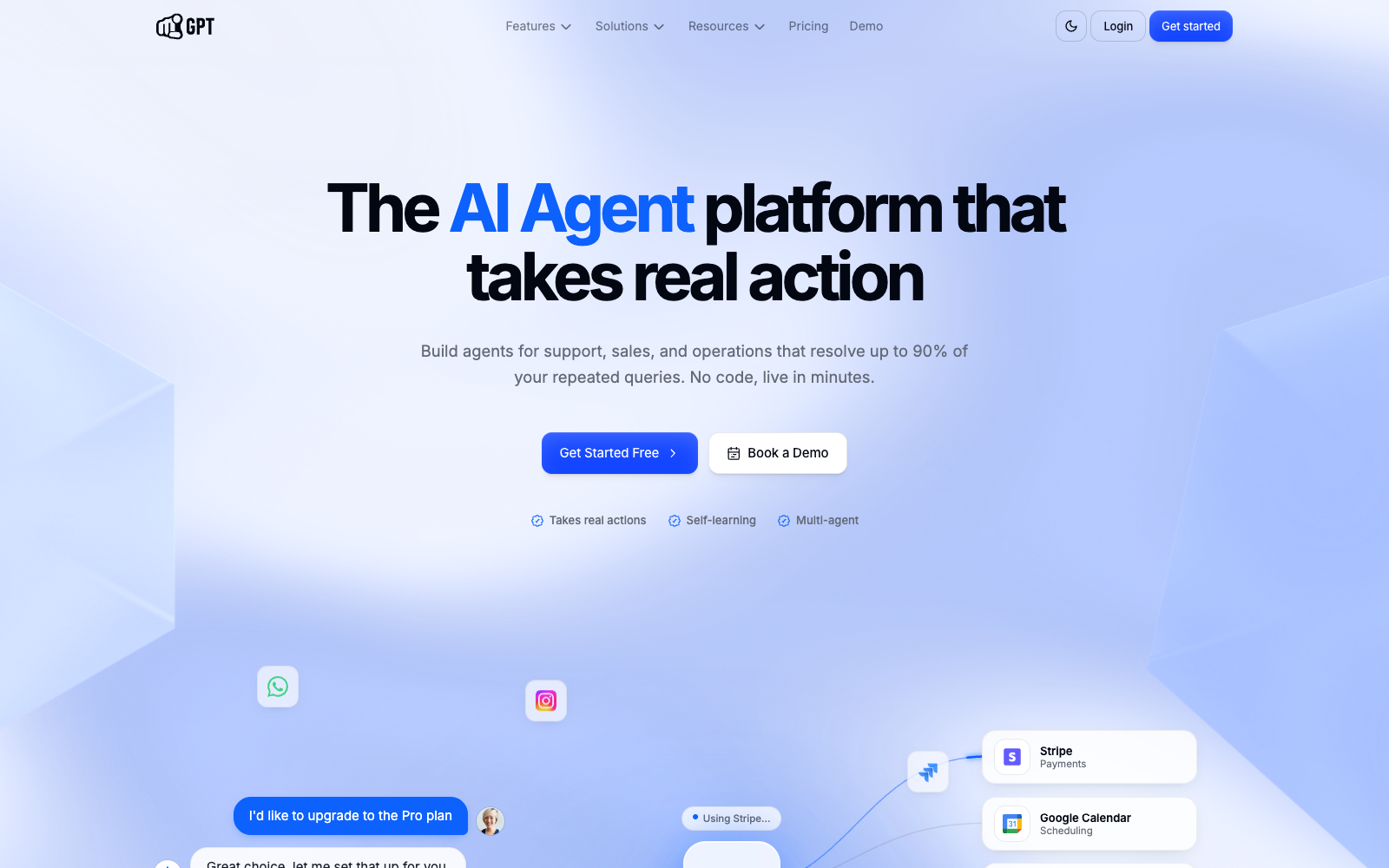
YourGPT is the closest like-for-like Chatbase alternative that goes further on the same idea. You still train agents on websites, files, and help content, but the platform adds functions, APIs, webhooks, a Studio for building flows, an AI helpdesk, and escalation to a human agent. The agent-count gap is the clearest difference. YourGPT pricing lists Essential at $39 a month billed annually with two chatbots and three seats, Professional at $79 with five chatbots, Studio, API access, and human escalation, and Advanced at $349 with ten. Chatbase includes one agent on every self-serve plan. The tradeoff is ownership. Tools, permissions, and test cases need a named owner, and every plan draws on an AI credit pool, so run real traffic before forecasting cost.
Pros
- Two to ten chatbots per plan, against one on every Chatbase plan
- Functions, APIs, webhooks, and Studio for action-taking agents
- AI helpdesk and human escalation on Professional
- Self-serve plans with monthly and annual billing
Cons
- More setup than a paste-a-URL chatbot
- AI credit consumption needs testing on real traffic
- Studio, API, and escalation start on Professional, not Essential
- Appointment booking needs a scheduling integration
3. Intercom Fin
Intercom Fin
Outcome-priced AI agentBest for: Support teams on Intercom, Salesforce, HubSpot, Freshworks, or Front that want an AI agent billed by result
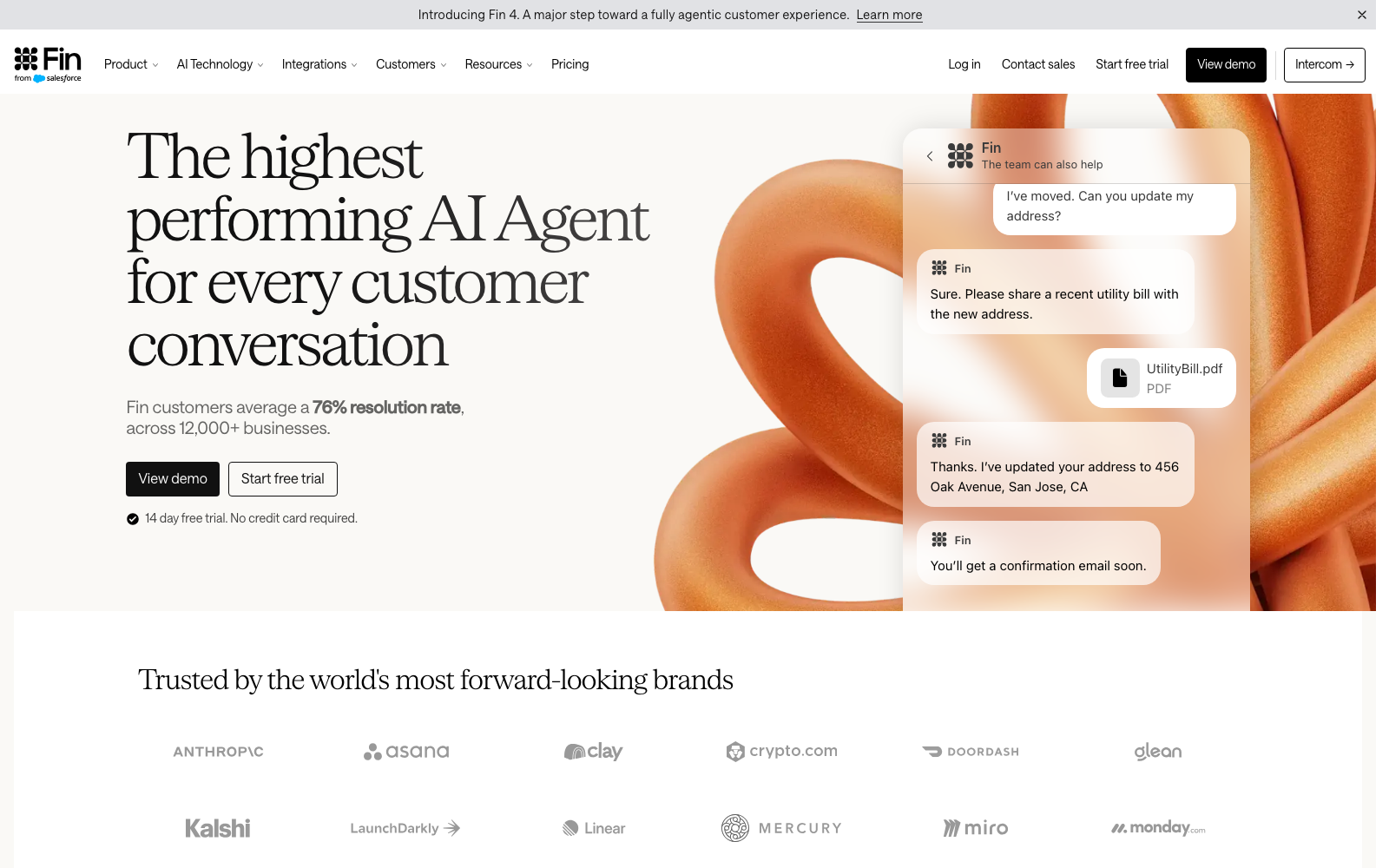
Fin is the Chatbase alternative for teams that want to pay for results rather than responses. Its homepage says customers average a 76% resolution rate across 12,000+ businesses. Fin pricing is $0.99 per outcome with a 50-outcome monthly minimum on your current helpdesk, and no extra seats. Named integrations include Salesforce, HubSpot, Freshworks, Front, Zoho, and Gorgias. On Intercom itself, Fin runs from $0.99 per outcome plus $19 per helpdesk seat. The meter is the point and the risk. A conversation with no outcome costs nothing, but resolutions, procedure handoffs, self-serve routings, and disqualifications each count at $0.99, and qualifications bill at $9.99. Model 500 and 2,000 outcomes on last month's volume before signing. Fin Voice is custom-priced through sales. Choose Fin when support already lives in a helpdesk and a clear per-outcome number beats a credit pool.
Pros
- Charges for outcomes, not every response
- Works on top of several existing helpdesks
- Publishes a clear per-outcome price and minimum
- Vendor-reported 76% average resolution across 12,000+ businesses
Cons
- Cost rises with success and with counted handoffs
- Qualifications bill at $9.99 each
- Voice pricing is custom
- No booking against staff, rooms, or service length
4. Botpress
Botpress
Developer-led agent platformBest for: Product and engineering teams building multi-step support agents that take real actions in their own systems
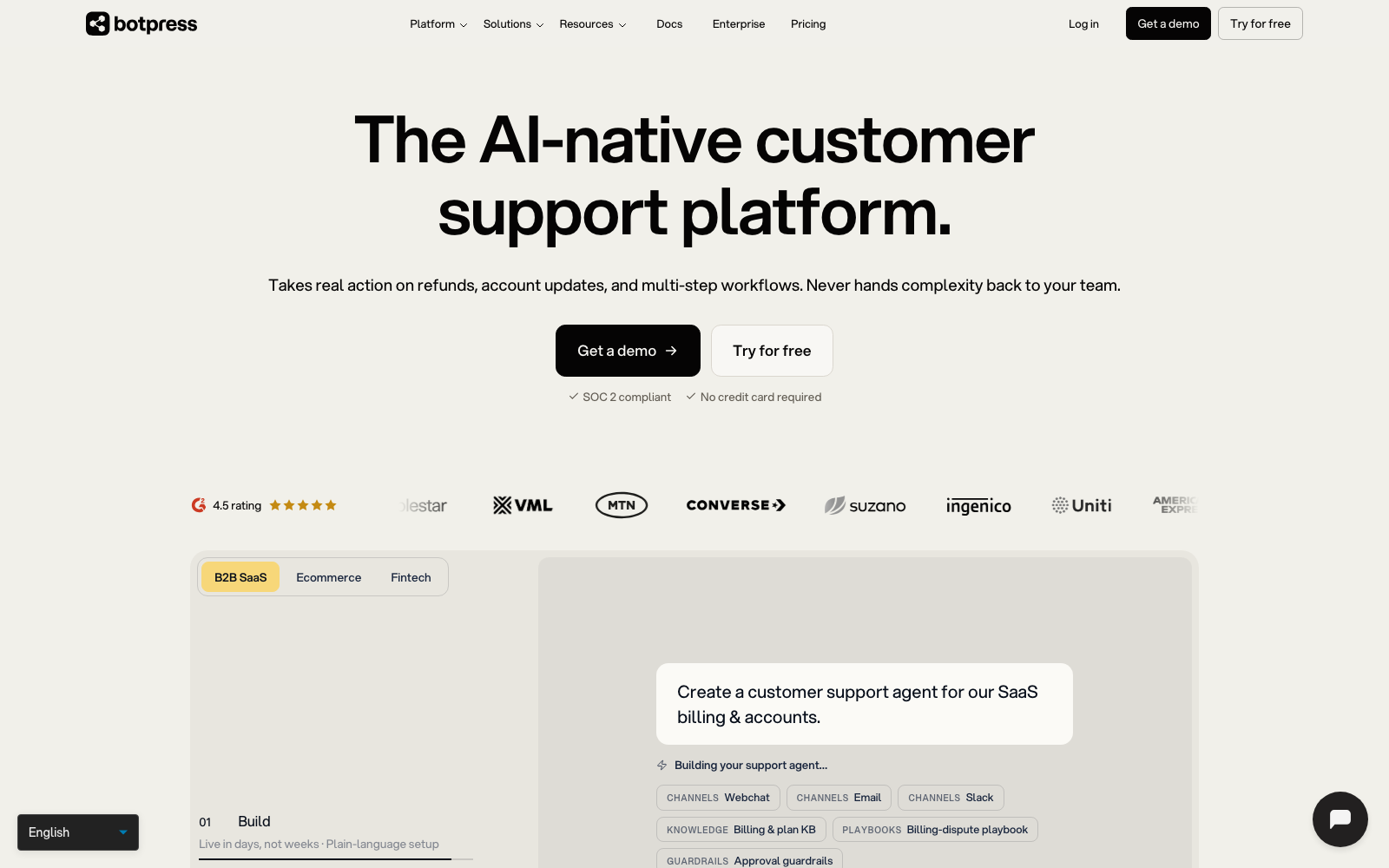
Botpress suits teams that outgrow Chatbase's action list and want to build the logic themselves. The homepage promises an agent that "takes real action on refunds, account updates, and multi-step workflows," with webchat, WhatsApp, Slack, and connections to Intercom, Zendesk, HubSpot, and Salesforce. Handoff passes the conversation, account details, and attempted steps to a person. Botpress pricing counts conversations and AI spend separately. Free includes 100 conversations a month. Plus is $150 a month billed annually with 250 conversations, $25 of AI usage, and extra conversations at $0.65 each. Team is $750 with 1,500 conversations. When AI spend nears its limit, Botpress buys a $10 credit grant automatically, which keeps the agent online but adds a line to watch. Budget developer time as well as the plan.
Pros
- Deep control over multi-step logic and actions
- Unlimited agents on paid plans
- Handoff passes history and attempted steps to staff
- Free plan large enough to prototype
Cons
- Two meters to forecast: conversations and AI spend
- Paid entry price is far above Chatbase Hobby
- Complex flows need developer ownership
- Booking against a live calendar is custom work
5. Voiceflow
Voiceflow
Chat and voice agent builderBest for: CX and product teams running chat and voice agents across web, app, WhatsApp, SMS, and phone
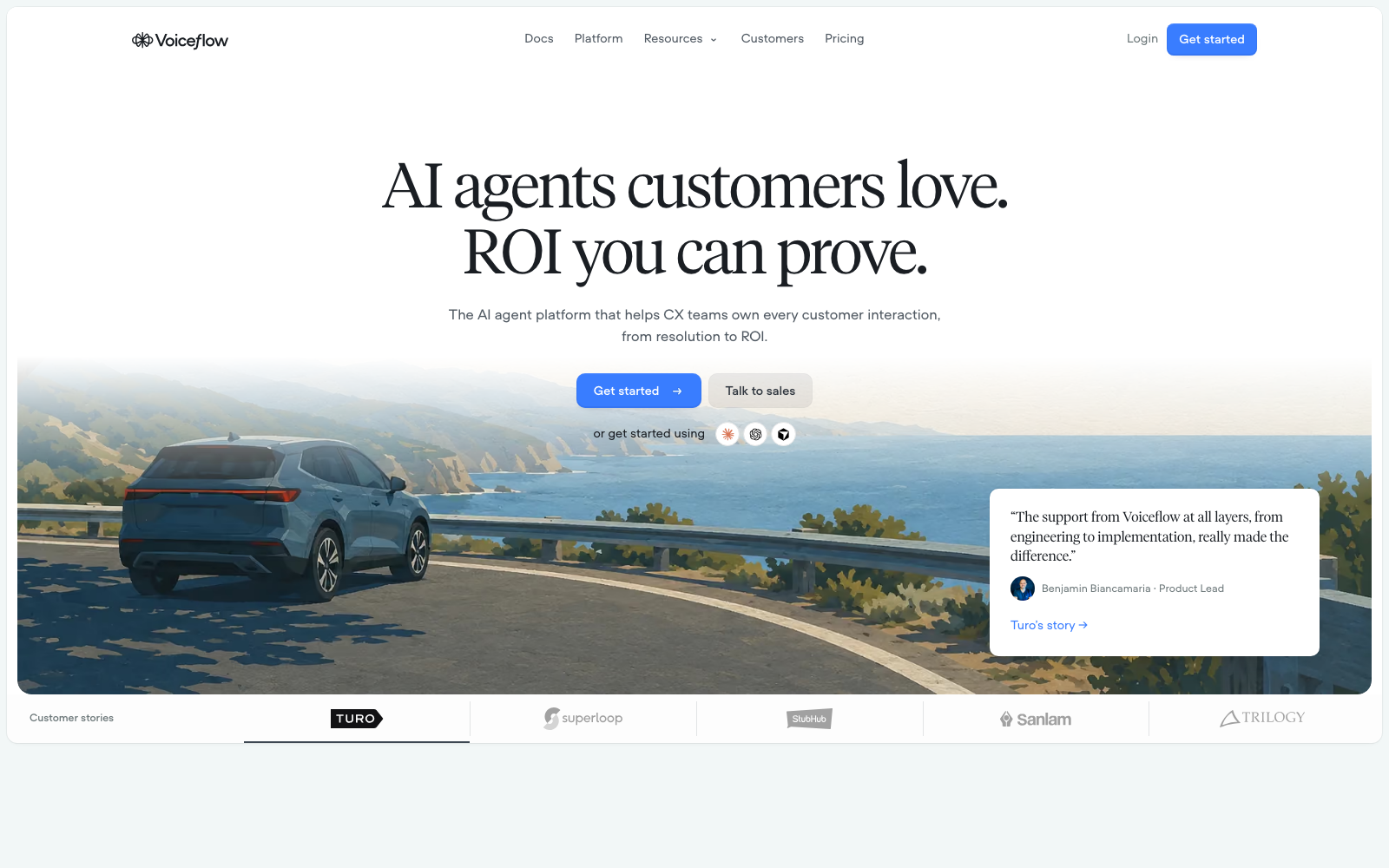
Voiceflow is the Chatbase alternative for teams that need one agent design across chat and voice, with collaboration and analytics for a whole CX group. It supports web, app, WhatsApp, SMS, and voice, and lists tools for Salesforce, Zendesk, Shopify, HubSpot, Twilio, Genesys, Five9, and Amazon Connect. The company cites 3,000+ customers, a 70% AI resolution rate at Trilogy, and StubHub going from concept to live in under 12 weeks. That timeline is honest about the category: this is a build, not a five-minute widget. Voiceflow pricing offers agencies a free trial with usage-based billing and asks businesses to request a price. Choose Voiceflow when voice and governance matter more than launch speed, and when a team will own the agent after go-live.
Pros
- One design surface for chat and voice
- Contact-centre integrations such as Genesys, Five9, and Amazon Connect
- Team collaboration, roles, and analytics
- Published enterprise outcomes from named customers
Cons
- No public business price list
- Longer path to live than Chatbase
- Needs a team to own design and testing
- Overbuilt for a small website knowledge bot
6. Tidio
Tidio
Live chat with an AI agentBest for: Small and mid-sized ecommerce stores that want human live chat and an AI agent in one widget
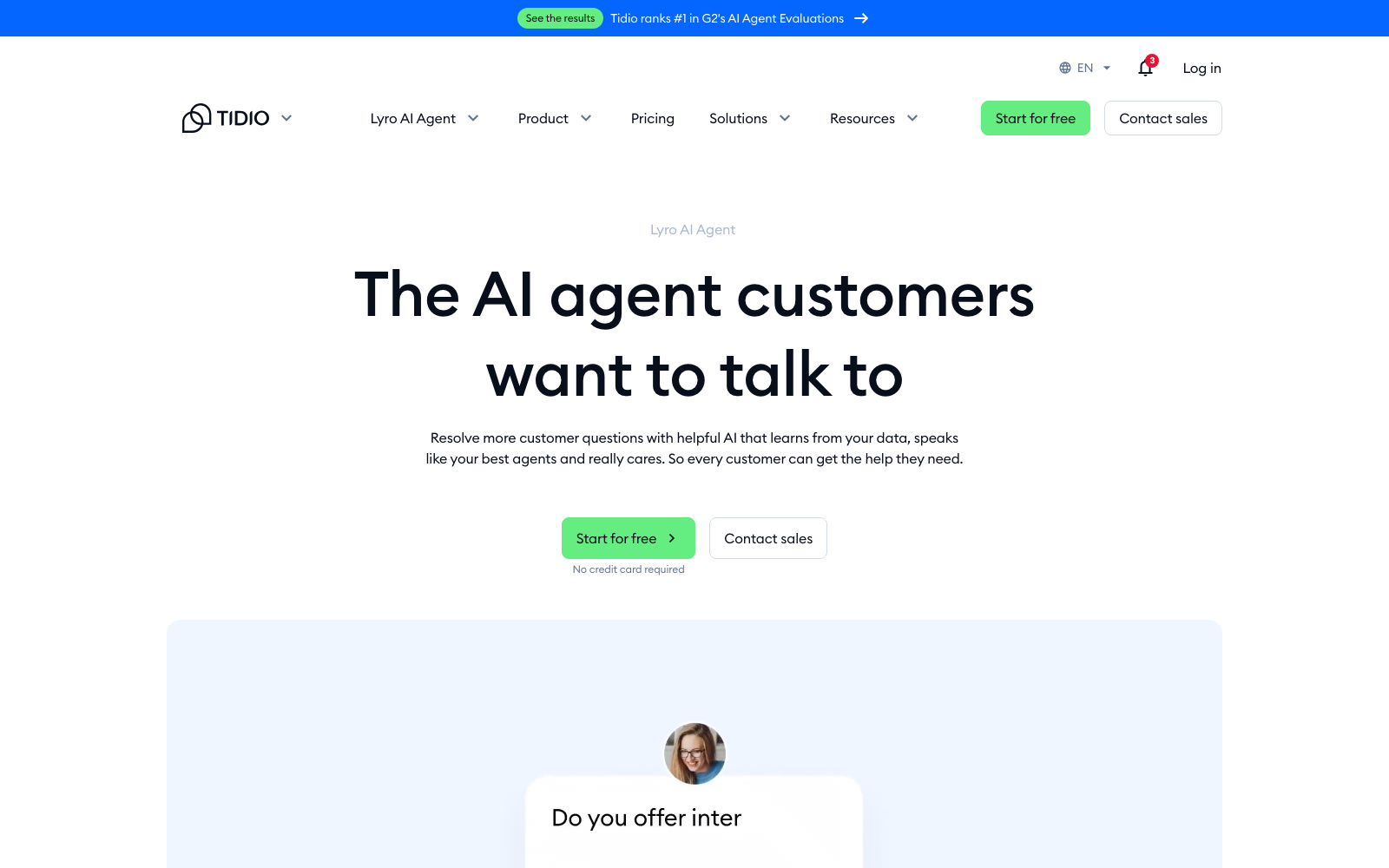
Tidio is the practical Chatbase alternative when a small store wants an AI agent and a human live-chat inbox in the same widget. Lyro learns from your content, and Smart Actions handle order updates, lead qualification, and routing tickets to the right department. The Lyro page says customers average a 75% resolution rate. Tidio pricing includes a free plan with 50 lifetime Lyro conversations, Starter from $24.17 a month on the annual toggle, and standalone Lyro from $32.50 a month for 50 conversations, with higher tiers up to 1,000. That cap is the catch. A store with a few hundred chats a week will climb tiers quickly, so price your real volume on the calculator. Standalone Lyro can be added to Zendesk, Salesforce, or another helpdesk, while Lyro Connect is listed only on Plus and Premium.
Pros
- AI agent and human live chat in one widget
- Smart Actions for order updates and lead qualification
- Free plan and low entry price
- Standalone Lyro can sit on an existing helpdesk
Cons
- Lyro conversation caps rise fast with traffic
- Plus starts at $300 a month plus usage
- Less control over custom actions than Botpress or YourGPT
- No booking against staff or service duration
When Chatbase is still the better choice
Keep Chatbase when one well-trained agent covers the job and the meter is predictable. The Chatbase plans are clear at the self-serve level: Hobby at $32 a month billed yearly with 700 credits, Basic at $120 with 4,000 credits and up to 10 concurrent voice calls, and Business at $400 with 15,000. The setup really is fast. A team with a clean help centre, a Notion workspace, or closed Zendesk tickets can have a grounded bot live the same day, and the action list now covers common order, invoice, and plan requests.
Do the credit maths before you stay. On a 2-credit model, Hobby's 700 credits are about 350 replies a month, or 700 on a 1-credit model. On Claude 5.5 Opus at 5 credits, Business's 15,000 credits are about 3,000 replies, and top-ups cost $40 per 1,000 credits. Removing the "Powered by Chatbase" badge is $1,188 a year. Leave when a second agent, a branded widget, and peak-week top-ups cost more than a platform that includes them, or when the job is a refund, a helpdesk outcome, a voice line, or a real booking.
A safer way to choose
Pick two finalists and give each one the same month of reality: twenty real conversations from your inbox, covering a routine question, a missing article, a frustrated customer, a refund, an account change, and a request that must reach a person. Add three questions the agent should decline and three that invite it to make something up. Score every conversation as resolved, escalated with context, or left for staff to fix.
Then run the Chatbase-specific tests. Drain a trial's credits, conversations, or AI spend and record exactly what a visitor sees at the limit. Count how many agents you actually need, for support, sales, or each location, and price that number. Price the widget without the vendor's badge. A plan that looks cheap with one branded agent can cost more than a rival once those three lines are added.
For appointment businesses, the last test happens outside the chat. Request a two-service visit at a busy time, then open the real booking system. The visit must be there with the right person, length, and slot, and the chat must say so only after it is. The AI receptionist demo checklist lists what to look for.
The right replacement is the product that keeps working on your busiest day, with a bill you predicted before it arrived.
Questions
Commonly asked questions
Not directly. Chatbase's actions can read slots from a Cal.com event or a connected Calendly event and book a meeting in the chat. That works for demos and consultations on one calendar. It does not read a salon or spa POS, a named stylist's column, or how long a colour takes. For that, test LLDTEK, and read AI receptionist vs chatbot for bookings first.
The agent stops answering. The Chatbase FAQ says visitors see "This AI Agent is currently unavailable" and owners should check the Usage page. Auto-recharge at $40 per 1,000 credits prevents that, but it turns a fixed plan into a variable bill. Set a recharge cap and an alert before a launch, a sale, or a holiday weekend.
It depends on the model. The FAQ lists 2 credits for models such as Claude 5.5 Sonnet and GPT-6.1, 4 for GPT-5.5, 5 for Claude 5.5 Opus, and 1 for all other models. Hobby's 700 credits cover about 350 replies on a 2-credit model. Business's 15,000 credits cover about 3,000 Opus replies or 7,500 on a 2-credit model. Each plan also lists a separate monthly allowance of test credits.
Botpress Free includes 100 conversations a month and three agents, which is enough to prototype a real flow. Tidio's free plan includes 50 lifetime Lyro conversations alongside live chat. Neither will carry a busy business on its own. The wider list of free options is in Free AI chatbot.
YourGPT is usually the better fit. Chatbase includes one agent per self-serve plan and charges $300 a year for each extra agent, while YourGPT's Professional plan includes five chatbots and Advanced includes ten. Voiceflow's agency plan is built for multi-client workspaces and white-labeling, but its pricing is usage-based rather than published as a flat rate.
Below about 400 outcomes a month, Fin costs less. The 50-outcome minimum is about $50, and 400 outcomes is about $396. Above that, Chatbase Business is cheaper until its 15,000 credits run out, then top-ups cost $40 per 1,000. Fin bills only when there is an outcome, while Chatbase bills every response. Qualifications on Fin cost $9.99, so price both on last month's conversations.
Export or collect your sources first: the URLs crawled, uploaded files, Q&A pairs, and the instructions that shaped answers. Rebuild them in the new platform, then run both agents in parallel on the same questions for a week. Rebuild actions and handoff rules before you swap the website snippet. Cancel Chatbase only after billing confirms the subscription has stopped.
Updated Nov 2, 2026.