Blog/Guides
Google AI Chatbot Guide for Consumers, Developers, and CX Teams
Google has several AI chatbot products. Choose Gemini for individual work, Google Cloud tooling for custom agents, and CX products for customer service operations.

Mateo Ruiz
Sep 7, 2026

“Google AI chatbot” can mean three very different things. A person may mean the Gemini app. A developer may mean Gemini models through Google AI Studio, the Gemini API, or Google Cloud. A customer-experience team may mean an agent built with Google Cloud’s conversational and CX products. Choosing the wrong layer wastes time because each is designed for a different job.
Last reviewed: 7 September 2026. Google changes product names, editions, and packaging frequently, so confirm the current Cloud documentation and commercial terms during procurement.
This guide separates those uses and gives each buyer a safer next step.
Choose the Google product by the work
Gemini for individual work
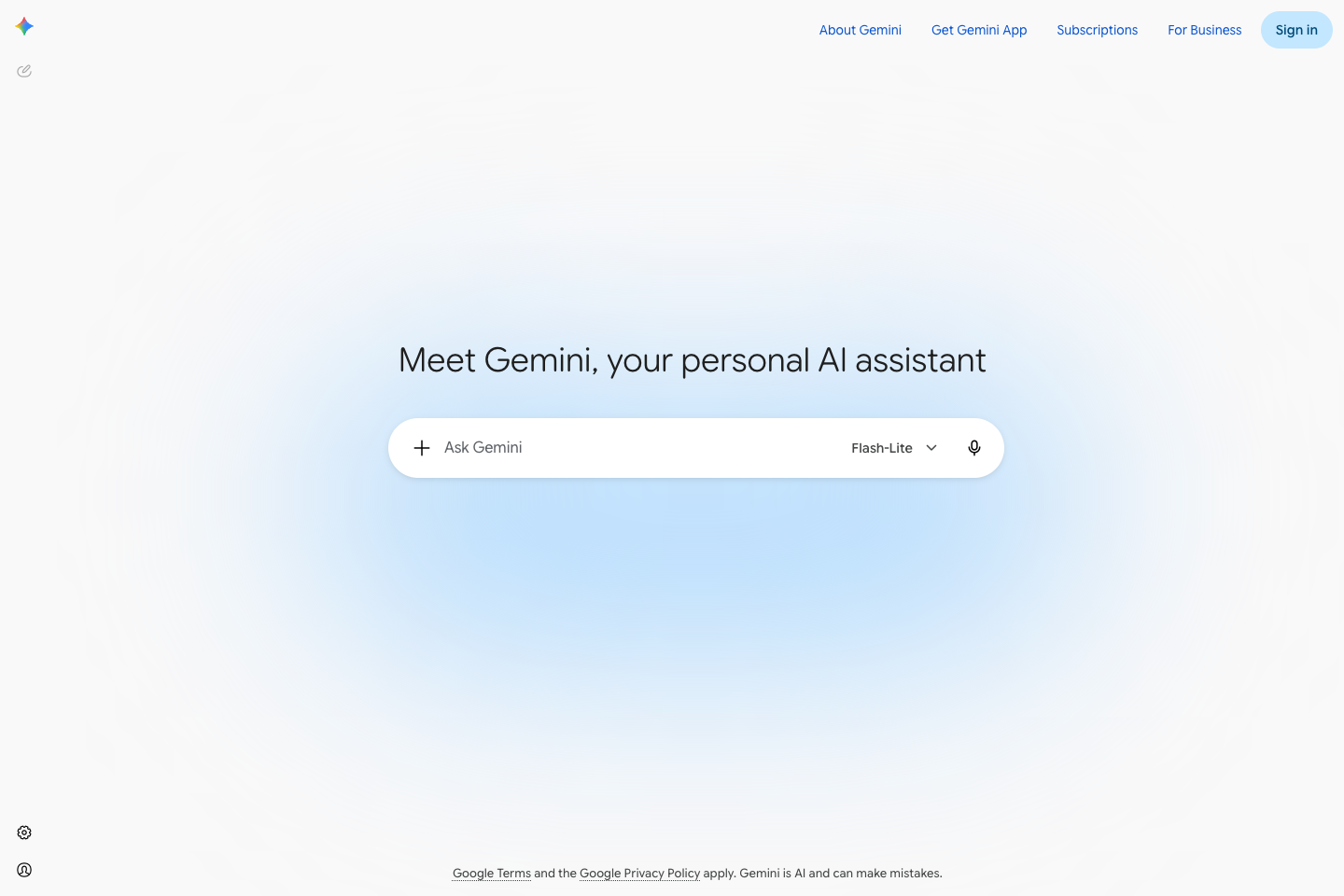
The Gemini app is Google’s general-purpose AI assistant for tasks such as drafting, summarising, analysing, and creating. It is the sensible starting point for an individual who wants help with everyday knowledge work or for a team assessing how an assistant fits into Google-centred workflows.
Use it with the same discipline as any general assistant. Provide the source material for important work, ask it to identify uncertainty, and verify external claims. Do not copy sensitive data into a personal account before understanding your company’s policy and the applicable product settings.
Google AI Studio and the Gemini API for prototypes
Google AI Studio and the Gemini API documentation are aimed at developers and builders who want to explore Gemini capabilities programmatically. This is the right layer for testing prompt design, structured outputs, multimodal inputs, and a narrow proof of concept.
Keep the prototype narrow. Use synthetic or approved data, log prompts and outputs, define a refusal path, and test how the model behaves when information is missing. A useful prototype tells you what system components are still needed. It does not pretend that a model call is an application.
Vertex AI for enterprise implementation
Vertex AI is Google Cloud’s platform for building and operating AI applications. It becomes relevant when the work needs cloud identity, data controls, evaluation, deployment, observability, and integration with the rest of a Google Cloud environment.
The key design decision is separation of concerns. Use retrieval to ground answers in approved material. Use deterministic systems for policy and transaction rules. Use tool permissions that are narrow enough to audit. A fluent assistant should never be allowed to infer a refund, an entitlement, or an account change from conversational context alone.
Gemini Enterprise for customer experience
Google Cloud describes Gemini Enterprise for Customer Experience as an agentic solution for customer experience, with configurable agents and a mix of generative and deterministic functionality. That combination is the right mental model for a customer chatbot: natural language helps people explain their problem, while defined logic protects important steps.
Ask the implementation team to demonstrate your highest-risk journeys. Test authentication, personal data, an unavailable inventory item, a policy exception, an ambiguous request, and a handoff to a human agent. The chatbot should preserve context and expose its action history to the service team.
How Dialogflow CX fits
Dialogflow CX is Google Cloud’s conversational-agent tooling for designing customer and voice interactions. It has traditionally been a place for structured flow design and is relevant to teams that need deterministic conversation state alongside newer generative capabilities.
Use it when you can map an actual service journey with states, inputs, integrations, and escape routes. A visual flow is valuable when it represents the policy your team would enforce manually. It is not a substitute for deciding what the policy is.
A practical selection path
Start by naming the user. If the user is an individual who needs help drafting, researching, or working with personal context, begin with Gemini and the relevant account controls. If the user is a developer building a product feature, prototype with Google AI Studio or the Gemini API, then decide whether the production requirements call for Google Cloud. If the user is a customer, start from the service journey, authentication model, and human-support process before selecting a conversational platform.
Do not skip directly from a consumer-chat experiment to a customer-service deployment. The interfaces can look similar, but a production agent needs a durable way to authenticate, retrieve current information, make or request actions, preserve conversation context, and expose failures to the team that owns the outcome.
Google Cloud implementation pitfalls
The first pitfall is using generative output where a deterministic rule is required. A model may help interpret intent, but it should not decide eligibility or invent a transaction state. Keep those rules in the service that already owns them.
The second is treating retrieval as a one-time upload. Sources change. A deployment needs content owners, indexing expectations, a way to trace the source behind an answer, and a correction process when the answer is wrong.
The third is ignoring the contact-centre handoff. The agent should transfer a complete summary, relevant identifiers, actions already taken, and the reason for escalation. Asking a customer to repeat a failed bot conversation is not automation; it is an extra queue.
The security and quality checklist
- Define which information the bot may read, which it may write, and which it must never access.
- Ground customer-facing answers in approved sources and retain citations for operators.
- Keep policy, payment, and eligibility rules in deterministic services where possible.
- Require confirmation or human approval for consequential actions.
- Test prompt injection, conflicting instructions, stale content, and unauthorised access.
- Monitor failures, escalations, and corrections after release.
Google tooling can supply models and platforms. The quality of the chatbot still depends on source governance, permission design, integration quality, and a clear owner for the workflow.
When Google is not the obvious choice
Choose a packaged helpdesk platform when customer service already lives in that helpdesk and the team needs a faster path to human-and-AI operations. Choose an agent builder such as Botpress when custom developer control is the priority. Choose an appointment-specific platform when the conversation has to become a booking against a live calendar rather than a support answer.
The right Google AI chatbot is the one at the right layer. Start with the job, then select the product family.
Questions
Questions about Google AI chatbots
No. Gemini is a model and assistant family, while Dialogflow CX is conversational-agent tooling in Google Cloud. A customer-service implementation can combine generative-model capabilities with structured conversation and business rules, but the products serve different layers of the stack.
It can be designed to use approved data with cloud identity and access controls, but safety depends on the implementation. Define data sources, permissions, retention, retrieval boundaries, and action permissions before exposing company or customer information to the agent.
Use deterministic logic for policy enforcement, transaction steps, eligibility, identity checks, and actions with material consequences. Use generative language where it helps the user explain intent, understand an answer, or navigate a known process.
Updated Sep 7, 2026.