Blog/Guides
Confluence AI Assistant vs Traditional Wiki Search: What Actually Changes
Atlassian's Rovo promises smarter Confluence search. See what actually changes in accuracy, coverage, and cost versus classic keyword search.
Sep 14, 2026 · 12 min read

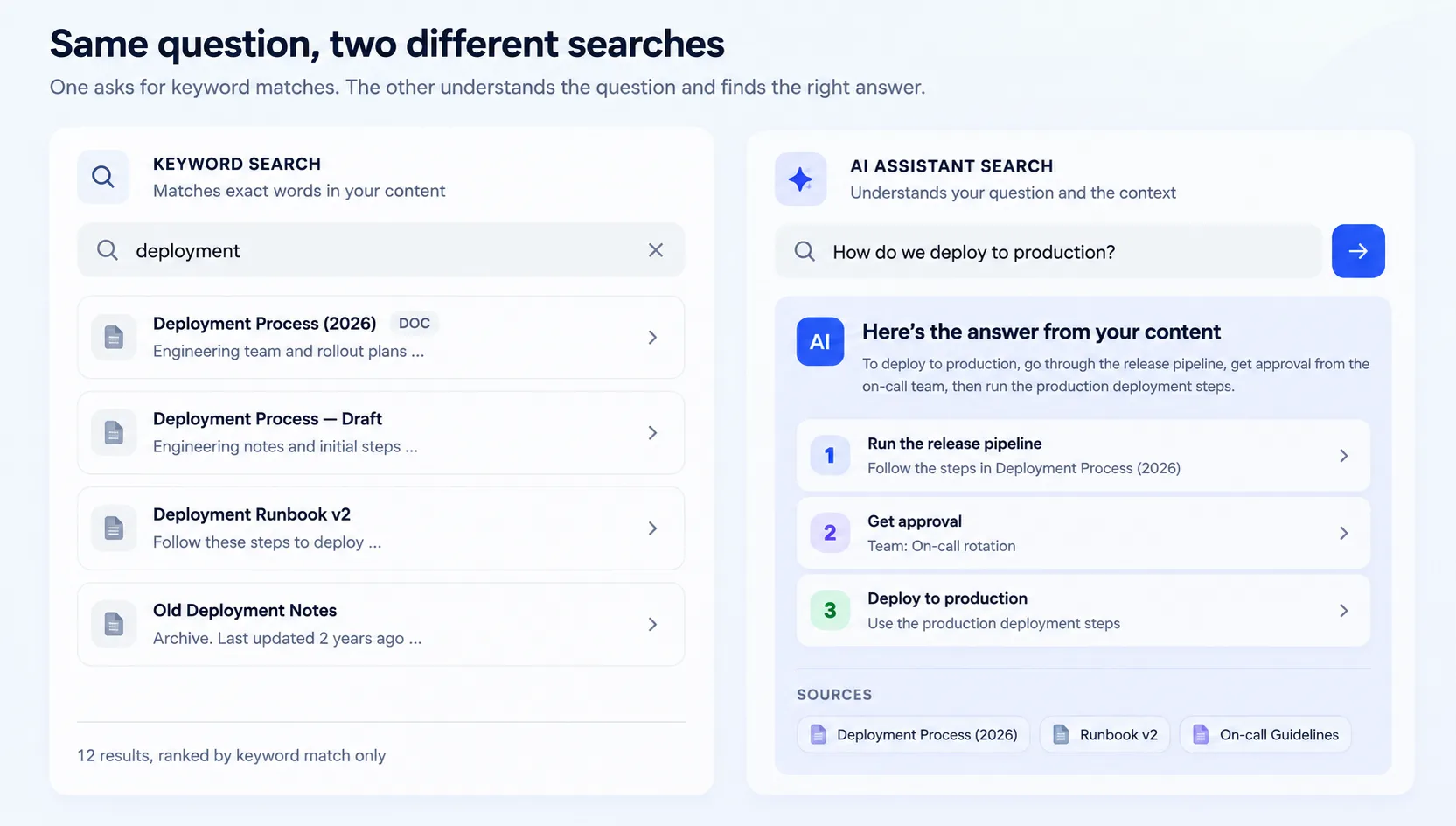
You type "deployment" into Confluence search and get twelve results back, ranked by nothing you can explain. Three of the top matches are titled almost the same thing. One of them is two years old and quietly wrong. You open three pages, still can't tell which one is current, and end up asking in Slack instead, hoping whoever answers actually remembers the right one.
Atlassian built Rovo and Atlassian Intelligence, the AI layer now sitting inside Confluence, to close exactly that gap. Type the question the way you'd ask a colleague, and get an answer back instead of a list of pages to sort through yourself. Whether that actually happens on your own wiki depends on what's broken underneath it. Sometimes it's the search. Sometimes it's the content nobody owns. Often it's both.
Last reviewed: 25 September 2026. This is a product and category comparison based on public documentation and independently reported testing, not a claim that every feature was verified inside the same customer environment.
The short verdict
Confluence's AI assistant is worth turning on once your team is on a paid plan, since AI-powered search itself is included at no extra credit cost and reliably beats keyword search on plain-language questions and cross-tool lookups. It is not a fix for a wiki nobody owns. Stale pages, duplicate spaces, and undocumented decisions confuse an AI answer exactly as they confuse a keyword search, only with more confidence in the wrong page.
What "traditional wiki search" actually means in Confluence
Classic Confluence search works the way most enterprise wikis do. Type a term, get pages that contain that term, ranked mostly by keyword match, space, and recency. Power users lean on Confluence Query Language (CQL), with operators like space = "ENG", label = "runbook", contributor = "jsmith", and exact-phrase quotes, to narrow results. Ctrl+F handles the rest once you've actually found the page.
The limits show up fast in a real organisation. Search only covers Confluence itself, not the Jira ticket, Slack thread, or Drive file that actually holds the answer. It needs the right label or the exact term someone used two years ago, not the term your team uses today. And it has no way to tell a current runbook from the one it replaced. Both rank the same.
Atlassian Intelligence and Rovo cover two different jobs
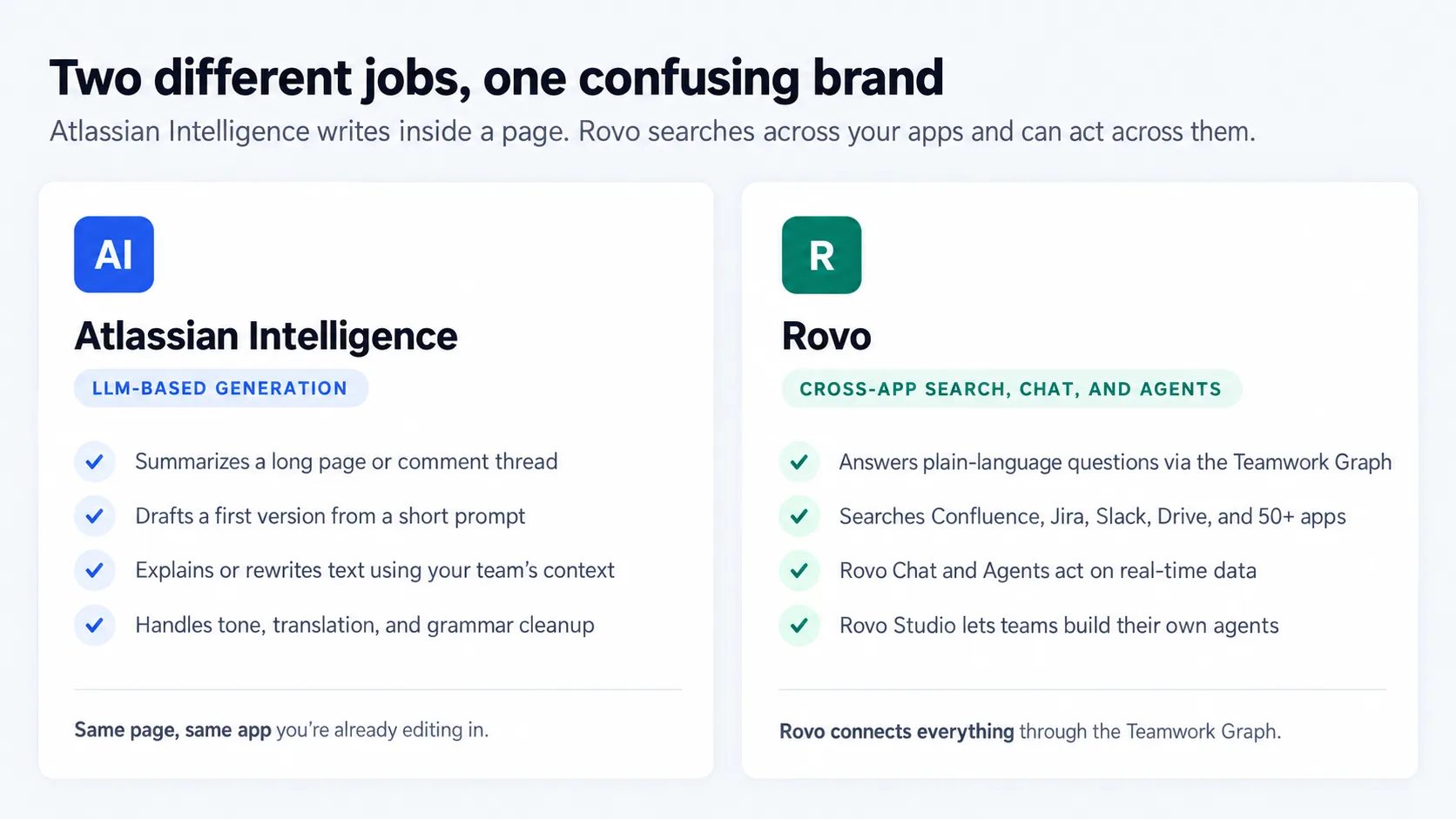
Buyers routinely conflate these two, and Atlassian's own marketing doesn't help. They do different jobs.
Atlassian Intelligence handles the in-editor work
Atlassian Intelligence is the generative AI built directly into the Confluence editor. It summarises a long page or comment thread, drafts a first version of a spec or meeting agenda from a short prompt, and lets you highlight any term on a page to get a definition written in your organisation's own context. Highlight "sprint velocity" and it can explain what that term means for your specific Jira workflow, not a textbook definition. It also handles tone changes, translation, and grammar cleanup.
Rovo handles search, chat, and agents
Rovo is the broader product. Atlassian took it to general availability in October 2024, rolled it out to Premium and Enterprise customers starting in April 2025, and began extending it to Standard plans between September and November 2025. Rovo's job is cross-app retrieval. Rovo Search answers questions using a proprietary relationship layer Atlassian calls the Teamwork Graph, which maps how your projects, people, pages, and tickets connect to each other. Rovo connects to more than 50 apps, including Jira, Confluence, Jira Service Management, Slack, Google Drive, GitHub, Figma, Salesforce, Notion, and Microsoft Teams. Rovo Chat and Rovo Agents sit on top of that same search layer for conversational answers and automated actions, and Rovo Studio lets teams build their own agents without code.
That split is worth understanding on its own, using the same knowledge-platform framework used to score Notion, Guru, and Glean elsewhere on this site. A governed-wiki problem and an enterprise-search problem are not the same problem, and Confluence now ships tools that address both under one confusing umbrella brand.
Confluence AI assistant vs traditional wiki search, side by side
Dimension | Traditional keyword search | Confluence AI assistant (Rovo) |
|---|---|---|
Query type | Exact words, labels, CQL operators | Plain-language questions |
Scope | Confluence spaces only | Confluence, Jira, Slack, Drive, GitHub, and 50+ connected apps |
Handles jargon and synonyms | No, needs the exact term used on the page | Yes, infers meaning from surrounding context |
Ranking logic | Keyword match, space, recency | Relevance inferred from the Teamwork Graph |
Freshness handling | Surfaces outdated pages equally | Same underlying pages, does not verify which is current |
Permission handling | Respects existing space permissions | Same permission model, no override |
Cost | Included on every plan | Search is free, Chat and Agents draw from a credit pool |
Availability | All plans, including Free | Premium and Enterprise since April 2025, Standard rolling out September to November 2025, none on the Free plan |
Where the AI assistant is a genuine upgrade
The clearest win is cross-tool retrieval. A new hire asking how deployment works can get back the actual runbook page plus the related Jira tickets and recent incident notes in one answer, instead of three separate searches across three separate tools. That kind of question, one with a single factual answer sitting somewhere in the Teamwork Graph, is where Rovo tends to earn its keep. Atlassian's own engineering blog reports that in an internal A/B test, Rovo Search returned 60 percent more successful results than the next leading enterprise search tool it was benchmarked against, with a further 10 percent gain on its internal quality metric since January 2025. Treat that as a vendor-run benchmark rather than a guarantee for your own content. Independent reviews of the rollout describe strong results on factual lookups and noticeably weaker ones on questions that need interpretation or judgment.
Highlight-to-explain is a smaller feature, but a useful one for onboarding, since it defines internal jargon using your own team's context rather than a generic dictionary entry. And Remix, which entered open beta in early 2026, converts a page section (a data table, a process description) directly into a chart, timeline, or presentation, which matters because pages with visual elements get read by a noticeably wider share of the team than plain text ones.
Where it will not fix your actual problem
An AI layer answers faster. It does not decide which of three conflicting pages is correct, and it does not assign an owner to the runbook nobody has touched since 2023. If the underlying problem is that nothing in your wiki has a clear owner or review date, Rovo will simply retrieve the wrong answer with more confidence than keyword search did.
Coverage is also uneven in ways worth testing before you rely on it. Confluence Databases, the structured-data blocks inside Confluence pages, are not fully indexed by Rovo Chat according to documented reports from Atlassian's own admin community, so content stored that way can go missing from AI answers even though it is sitting in plain view of a person browsing the page. Some admins have also flagged the assistant inserting itself uninvited, for example auto-assigning a ticket while someone is mid-sentence in a comment box, which is a UI friction problem worth testing on your own team before a wide rollout.
There is no free ride here either. The Free Confluence plan gets none of this, and teams still leave their chat tool to ask a Confluence or Jira question, since Rovo has no native residency inside Slack or Teams beyond basic connectors.
The same trust problem reaches customer-facing agents too
The stakes are not only internal. Some teams point a customer-support AI agent at the same Confluence space, so a policy page or a pricing page becomes the exact source the agent quotes back to a paying customer. A stale or duplicate page that only wastes an employee's ten minutes becomes a wrong answer stated confidently to someone outside the company.
Support-focused agent platforms such as YourGPT handle this by scoping which sources an agent is allowed to draw an answer from and requiring an approved, current source, rather than treating an entire connected wiki as fair game. The ownership and freshness work that makes Rovo useful internally is the same work that keeps an external-facing agent from repeating a mistake in public.
Security and compliance basics before a wide rollout
Rovo has completed external assessment and holds SOC 2 and ISO 27001 certifications, per Atlassian's published security documentation. That covers the infrastructure Atlassian runs. It says nothing about whether your own spaces are configured correctly, since Rovo's search still respects whatever permissions already exist on a page, nothing more and nothing less. A space that's technically open to "anyone with access to this site" stays exactly that open once AI search can find it faster.
Before turning Rovo on broadly, pull a report of every space with loose or inherited permissions and treat cleaning that list as the real security review, ahead of anything a vendor's compliance page can tell you.
What it costs, in credits and dollars
Rovo Search itself does not consume credits. Rovo Chat and Agents cost 10 credits per request, and Deep Research costs 100 credits per request. Those credits come bundled with paid Confluence Cloud plans. Standard includes roughly 25 credits per user, Premium 70, and Enterprise 150, and Atlassian's pricing structure for this is set to change again from the end of August 2026 onward. Heavy agent use, particularly automated code or document review, can burn through an included pool faster than the sticker price suggests.
That's the same category of procurement question worth asking any enterprise search vendor, not just Atlassian. Ask which users are licensed, what happens past the included credit pool, and whether a quote covers the workload you actually plan to run, not a demo-sized one. The procurement checklist used for evaluating Glean applies here almost without editing.
Confluence AI vs a dedicated layer like Glean or Guru
Rovo only searches as far as its connector list reaches, and its deepest, most reliable coverage stays inside Atlassian's own products. A team whose real knowledge gap spans a CRM, a support desk, and a dozen tools Atlassian doesn't prioritize is often better served by a platform built around cross-system retrieval as its main job, the same case made for evaluating Glean against a distributed knowledge estate.
The trade-off runs the other way for a team that already lives inside Jira and Confluence. Rovo's context comes bundled into a plan they're already paying for, with no separate procurement cycle. Buying a governed-answer layer like Guru on top of that only pays off once the questions people actually ask routinely cross outside Atlassian's walls, not before. Run both against the same ten questions used in the evaluation below rather than trusting either vendor's demo.
How to evaluate it on your own content
Generic evaluation steps don't tell you much. Run this against your own spaces instead.
Pull ten real questions from Slack history, not hypothetical ones. Include at least one that only makes sense with jargon your team invented, like a feature codename or an internal acronym.
Run each through classic search first, using CQL rather than the plain search box for a fair comparison. Something like
text ~ "deployment process" AND space = "ENG" AND label = "runbook". Record whether the top result was correct and how long it took to construct that query.Run the same ten through Rovo Chat, typed exactly the way a new hire would ask them out loud. Record the same two things.
Flag any question where the correct answer lived outside Confluence, in a Jira ticket, a Slack thread, or a Drive file. That's where the gap over keyword search should be largest, and where Rovo earns its cost.
Check that permission-sensitive content never surfaces to a role that shouldn't see it. Test with an account that's actually outside the space, not an admin account that happens to see everything anyway.
Note every duplicate, outdated, or contradictory page the assistant surfaces during the test and assign it an owner on the spot. An assistant retrieves faster. It does not decide which of three conflicting pages is true, and it will keep quoting the wrong one until a person fixes the source.
Do the credit math before you commit to a rollout, not after. Each seat contributes credits into one shared, organisation-wide pool rather than a personal allowance, so a 50-person team on Standard (roughly 25 credits per seat) pools around 1,250 credits a month. At 10 credits per Rovo Chat request, that funds roughly 125 Chat conversations across the whole organisation each month, not per person, before anyone touches Deep Research at 100 credits a request. Premium's 70 credits per seat and Enterprise's 150 stretch further, but the same math applies either way. A handful of people running frequent, multi-step Rovo Chat sessions can burn through a shared pool well before the seat count would suggest. Atlassian's own support community has admins doing exactly this math out loud, which is worth reading before you assume the credit line item is a rounding error.
Questions
Frequently asked questions
No. Rovo has been available on Premium and Enterprise plans since April 2025, and rolled out to Standard plans between September and November 2025. The Free Confluence plan does not include it, and teams on Free still rely entirely on classic keyword search.
Atlassian Intelligence is the generative AI built into a single product, used for summarizing, drafting, and explaining terms inside the Confluence editor. Rovo is the broader layer built on the Teamwork Graph that powers cross-app search, chat, and autonomous agents across Confluence, Jira, and more than 50 connected apps.
Yes, through connectors, though depth of coverage varies by app and content type. Some content, such as data stored in Confluence Databases, is not fully indexed yet, so it's worth testing your own highest-value sources before assuming full coverage.
Rovo Search itself is free and unlimited. Rovo Chat and Agents use 10 credits per request and Deep Research uses 100 credits per request, drawn from a pool bundled into each paid plan. Confirm current allocations and pricing directly with Atlassian, since the credit structure has changed more than once since Rovo's 2024 launch.
Yes. Classic search and CQL operators still work exactly as before. Many admins keep both in active use, since CQL remains more precise for exact, structured lookups like a specific label or a specific author's pages.
Rovo has completed SOC 2 and ISO 27001 assessments at the infrastructure level, but that audit does not cover your own space permissions. Confirm which spaces are open to broad access before trusting AI search to keep sensitive pages contained, since Rovo enforces whatever permission model already exists rather than adding a new one on top.
Final verdict
Turn on Rovo Search once your team is on a paid Confluence plan. It costs nothing extra, respects the permissions you already have, and reliably closes the gap classic keyword search leaves open on cross-tool and plain-language questions, the ones that send people to Slack instead of the wiki in the first place.
Hold off on leaning hard into Rovo Chat and Agents until someone owns the content problem underneath it. An AI layer retrieves faster. It does not decide which of three conflicting pages is true, and a credit-metered assistant answering with total certainty from a two-year-old runbook is a more expensive way to be wrong than a keyword search ever was.
Score the platform and the wiki separately. If the wiki fails the evaluation above, fix ownership and freshness first, using the same knowledge-platform criteria applied to Notion, Guru, and Glean elsewhere on this site, pointed at Confluence itself. If the wiki passes and search is still the bottleneck, Rovo is worth the rollout.
Updated Sep 29, 2026.