Blog/Guides
Chain-of-Thought Prompting Strategies for AI Agents
See how chain-of-thought prompting stops AI agents from guessing, why it breaks on voice calls, and a vendor checklist to test it yourself.
Sep 17, 2026 · 10 min read

Chain-of-thought prompting sounds abstract until you watch it fix a wrong price. Ask an AI model this, with nothing else attached. "A $90 color service gets a 20 percent loyalty discount, applied first. After that, a $15 first-visit coupon comes off what's left. What does the client actually owe?" A model answering in one shot will often subtract the coupon first, then take the percentage off what remains: $90 minus $15 is $75, and 20 percent off that lands on $60. That is the wrong order, and it is three dollars short of what the policy actually charges.
Now add a single line before the question. "Work through this step by step, applying the discounts in the order stated, before answering." The same model now writes out the steps in the correct order: $90 × 0.80 = $72 after the loyalty discount, then $72 minus $15 = $57 after the coupon. Fifty-seven dollars, matching the stated policy exactly, in an order a front-desk manager could check against the receipt in ten seconds. Nothing about the model changed between those two answers. The only thing that changed is that it was told to show its steps, in the right order, instead of guessing at the end.
That one-line difference is the entire idea behind chain-of-thought prompting, and for an AI agent that books appointments, quotes prices, or reschedules a client, it is the difference between an agent that gets the math right and one that just sounds like it did.
What is Chain-of-thought (CoT) prompting?
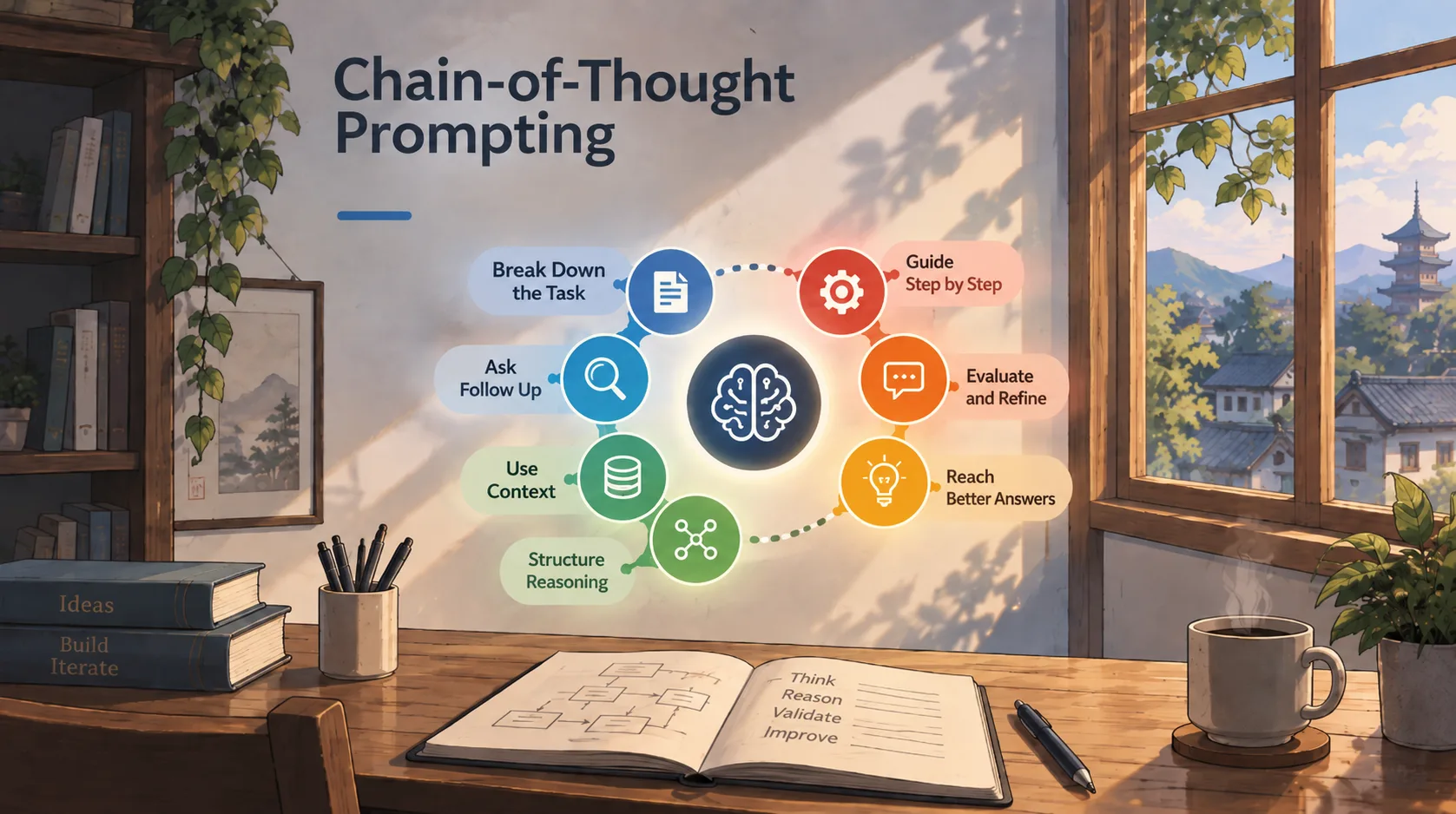
It is an instruction that gets a language model to generate its intermediate reasoning steps before it commits to a final answer, instead of producing a conclusion directly. Google researchers first documented the technique in 2022, showing it meaningfully improved accuracy on multi-step math and logic tasks. For an AI agent running real bookings, the same mechanism applies to calendars, pricing, and policy instead of word problems.
The original research is not vague about the payoff either. In that 2022 paper, prompting a 540-billion-parameter model with eight worked chain-of-thought examples reached a new state-of-the-art 58 percent accuracy on GSM8K, a benchmark of grade-school math word problems, ahead of a separately fine-tuned model that had its own verifier bolted on. Appointment pricing is not a research benchmark, but it is the same failure mode the paper documents. A model trained to imitate confident, well-formatted answers will produce one whether or not the underlying steps actually got followed.
Why Agents Guess Instead of Reasoning by Default
Language models are trained to predict the next likely word, not to think before they speak. Given a question shaped like a math problem, the fastest path to a plausible-looking answer is often a shortcut. Skip a step. Misread a phrase. Apply the first pattern that matches instead of the correct one. This is not a flaw unique to smaller or cheaper models. It shows up in frontier models too, whenever a prompt gives the model permission to answer immediately.
Reasoning instructions remove that permission. They force the model to generate a visible path from the question to the answer, and each step in that path constrains the next one. A model that has just written "the customer used 6 of 10 visits" cannot as easily contradict that fact three lines later, because the fact is now sitting in its own output, feeding back into what it generates next.
This matters more for an appointment agent than it does for a chatbot answering FAQs, because a wrong guess about a slot or a price does not stay contained to the conversation. It becomes a double booking, a wrong invoice, or a client the front desk has to call back and apologize to.
Three Chain-of-Thought Patterns Worth Using in Production
Most teams building appointment or service agents end up using some combination of three reasoning patterns. Which one fits depends on how much a request varies and how expensive a wrong answer is.
1. Zero-shot reasoning for one-off checks
A single instruction, such as "reason through the caller's request step by step before responding," is often enough for a straightforward availability check. No examples needed, no setup. This is the cheapest pattern to add and the right default for anything with a clear, narrow decision, like whether a slot is free or whether a stylist is working Tuesday.
2. Few-shot reasoning for policy-heavy requests
Cancellation windows, deposit rules, and no-show fees vary enough between businesses that a single instruction is not reliable. Showing the model two or three worked examples of how a similar request was reasoned through, before asking it to handle a new one, gets far more consistent results. A restaurant's deposit policy for parties over six people is exactly the kind of rule that needs a worked example rather than a sentence of instruction, because the exceptions matter as much as the rule itself.
3. Self-verification before anything touching money or a record
After the model produces a reasoned answer, a second pass asking it to check its own work catches a surprising number of errors, especially with tiered pricing or insurance and copay logic. A clinic checking whether a patient's plan covers a same-day add-on benefits from this second look before the appointment is confirmed rather than after.
Why This Breaks on a Live Phone Call, and the Fix
Every reasoning step a model works through adds generation time before it can respond. On a chat window, an extra second behind a typing indicator is invisible. On a phone call, dead air past a second or two reads as a dropped line, and callers start repeating themselves or hang up and try the front desk directly.
This creates a real conflict. The same step-by-step reasoning that makes an agent's math trustworthy is, handled carelessly, exactly what makes it feel slow on a channel where speed is half the experience.
Two fixes solve this, and most production voice agents use both together.
The first is to keep the reasoning internal and speak only the decision. A prompt instruction such as "reason through the following steps, then respond to the caller with only your final answer in one or two sentences" produces the same accurate chain of thought, but the caller only hears the last sentence of it. A home-services agent matching a technician's skill, location, and job urgency during a live call is running several steps of reasoning in the time it takes to say "let me check, yes, Marcus can be there by three."
The second is to scope full reasoning to the requests that actually need it. A question about today's hours or whether a service exists does not need a multi-step reasoning chain, and forcing one onto it just adds latency with no accuracy gain. Save the reasoning budget for anything touching two calendars, a price, a policy exception, or a record, and let the simple lookups answer immediately.
A Vendor Evaluation Checklist for Reasoning
If you are the one evaluating an AI agent platform rather than building one, you will not see any of this in a sales demo unless you ask for it. Four questions expose the difference between an agent that reasons and one that pattern-matches convincingly.
Does it check your actual calendar and policy state before confirming, or does it answer from a general pattern of what bookings usually look like?
Does anything involving money, insurance, or a duration change get a second verification pass before it is finalized?
What happens when the request is genuinely ambiguous, does it guess or hand off to a person?
Can you see the reasoning trail in a call transcript, or only the final message?
The answers look different depending on the kind of business behind the calendar. A salon's version of this problem is chair time and stylist skill. A clinic's version is insurance eligibility and appointment type. A restaurant's version is table turns and deposit thresholds. The reasoning core is the same, but what it checks against changes with the book of business, which is why the solutions built for each kind of floor look different even when the underlying agent logic does not.
A Reusable Reasoning Prompt Framework
For teams building their own agent logic, this structure covers most booking and service scenarios without turning every prompt into a wall of instructions.
Task: [the specific request, in the customer's own words]
Context: [relevant policy, price list, calendar state, or constraints]

Reason through the following before answering:
1. What is actually being requested
2. What constraints apply (availability, policy, price, duration)
3. What the correct action is, and whether anything is uncertain

Respond to the customer with only the final decision, in plain language.
Do not show your reasoning steps in the response.
If any step is uncertain, stop and hand off instead of guessing.
The last line matters more than it looks. A reasoning chain that ends in "I'm not sure" and a handoff is a success, not a failure. An agent that reasons its way to a confident wrong answer costs more than one that admits it does not know, because the wrong answer is the one that costs a booking or a returning customer.
A few-shot version, for policy-heavy requests
The framework above is zero-shot, and it holds up until a policy has real exceptions, like the deposit rule mentioned earlier. For those, replace the single instruction with two or three worked examples ahead of the new request.
Example 1
Task: Book a table for 4 people this Friday at 7pm.
Reasoning: Party size is 4, under the 6-person deposit threshold. No deposit required.
Answer: Table for 4 confirmed for Friday 7pm, no deposit needed.

Example 2
Task: Book a table for 8 people this Saturday at 8pm.
Reasoning: Party size is 8, over the 6-person deposit threshold. A $10-per-person deposit is required before the booking is confirmed.
Answer: Table for 8 held for Saturday 8pm, pending an $80 deposit.

New task: Book a table for 7 people next Tuesday. The customer says they already paid a $50 deposit by phone last week.
Reasoning:
Following the pattern from the two examples, the model works out that a party of 7 is over the threshold, so the $70 deposit applies, and $50 is $20 short of that. The correct answer confirms the booking is pending, not pending a fresh deposit and not confirmed outright, and asks for the remaining $20. That distinction, a top-up instead of a duplicate charge, is exactly the kind of judgment call a single zero-shot instruction tends to miss and a couple of worked examples reliably catch.
Questions
Frequently asked questions
It is asking an AI model to generate its reasoning steps before giving a final answer, the way a teacher asks a student to show their work on a math problem, instead of grading only the answer at the bottom.
Yes, each reasoning step adds generation time before the model can respond, which shows up as dead air on a call. Production agents work around this by keeping the reasoning internal and speaking only the final decision, and by limiting full reasoning to requests complex enough to need it.
Zero-shot CoT is a single instruction, such as "think through this step by step," with no examples attached. Few-shot CoT gives the model two or three worked examples of the reasoning pattern first, then asks it to apply the same pattern to a new case. Zero-shot is faster to set up. Few-shot holds up better on policy-heavy tasks with real exceptions, like cancellation windows or tiered pricing.
No. Simple lookups, like store hours or whether a service exists, do not benefit from a reasoning chain and only add latency. Reasoning earns its cost on requests with more than one moving part, such as a reschedule that touches two calendars, a price with a discount stacked on it, or a policy exception.
Ask what happens with an ambiguous or unusual request in a live test, not a scripted demo. An agent that is reasoning will check real constraints and hand off when something is uncertain. An agent that is pattern-matching will confirm something that sounds plausible, whether or not it is actually possible against the calendar.
Conclusion
Chain-of-thought prompting is not a universal upgrade, and treating it like one is how a booking agent ends up hesitating over "what are your hours" while still mishandling a genuine edge case. The rule that holds up in production is narrower and more useful than "always reason." Reason hard on anything with more than one moving part. Verify anything touching money or a record. Keep the reasoning invisible on a voice channel. Hand off the moment a step comes back uncertain instead of letting the model guess past it.
If you are building the agent yourself, that is the whole framework, applied consistently rather than cleverly. If you are buying one, it is the four questions from the checklist above, asked out loud in a live demo instead of taken on faith. Either way, the value chain-of-thought prompting actually adds is not smarter-sounding answers. It is an agent that knows the difference between a question it can answer and one it should not guess at, and books your calendar accordingly.
You can watch that distinction hold up against your own hours, policies, and calendar on a 30-minute demo call.
Updated Sep 29, 2026.